




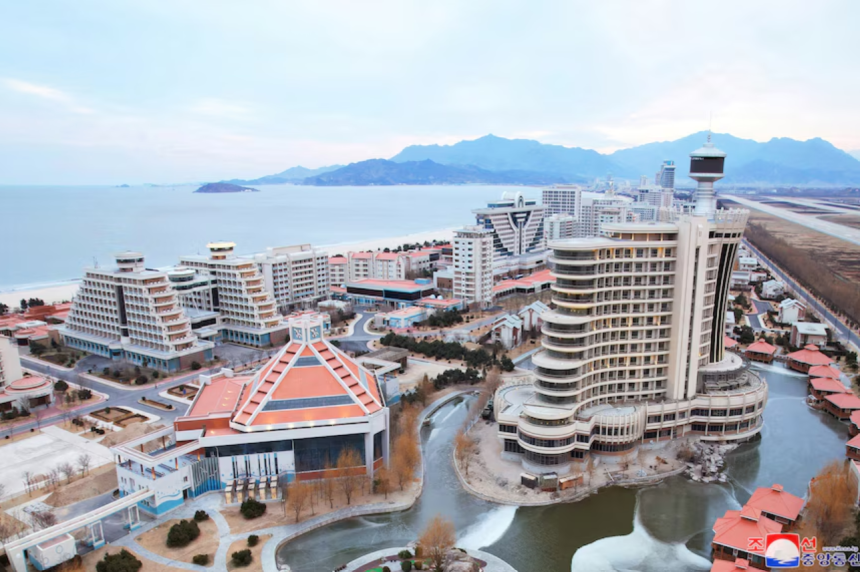
North Korea has officially opened its largest coastal tourist development—the Wonsan-Kalma coastal resort—marking a high-profile domestic initiative even as international travel remains largely barred.
Grand Opening with Domestic-Only Tourism
On June 24, Kim Jong Un inaugurated the 4-kilometer-long Wonsan-Kalma resort, designed to host up to 20,000 visitors and featuring hotels, restaurants, water parks, sports facilities, and beachfront recreation. However, authorities confirmed the resort will initially serve only North Korean citizens starting July 1, with no timeline yet for welcoming foreign tourists .
Economic Ambitions Behind the Shoreline
Kim hailed the project as “one of the greatest successes” of the year and touted it as a pivotal step toward revitalizing tourism—one of the few economically viable sectors under tight international sanctions. Observers note that without allowing international visitors—especially from China and Russia—the resort’s economic sustainability will remain in question.
Diplomatic Signals: Russia Welcomed, China Waiting
Russian diplomatic staff attended the ribbon-cutting ceremony, reflecting deeper Pyongyang–Moscow ties and hinting at potential Russian-launched tours. Chinese group travel, which had been dominant pre-pandemic, remains suspended—underlining ongoing bilateral strains.
Internal Push for Tourism Expansion
State media framed Wonsan-Kalma as a harbinger for more “large tourist zones” across North Korea, in line with long-standing plans dating back to 2014—now called to fruition despite sanctions and material-sourcing challenges.
Barriers to Global Visitors
North Korea’s borders remain effectively sealed to most foreign tourists after the COVID-era shutdown in 2020, despite limited reopening to Russian groups from early 2024. Restrictions on American and South Korean visitors, and broader political tensions, make reopening unlikely in the short term.
Strategic Implications
The Wonsan venture underscores Pyongyang’s attempts to diversify its economy and project normalcy. At the same time, it highlights reliance on Russia and the economic pressures nudging the regime toward re-engaging Chinese tourism—dependent on geopolitical recalibration .
What Comes Next
- Domestic rollout kicks off July 1.
- Russian tourism likely to be piloted first.
- Chinese revival contingent on diplomatic progress.
- Potential future resorts to follow, contingent on the success of Wonsan-Kalma’s model.
North Korea’s seaside showcase offers a rare glimpse of a nation eager to recast itself as a tourist destination—under tightly controlled conditions. Whether Wonsan-Kalma becomes an economic lifeline or shows the limitations of tourism isolation could determine Pyongyang’s next strategic turn.