




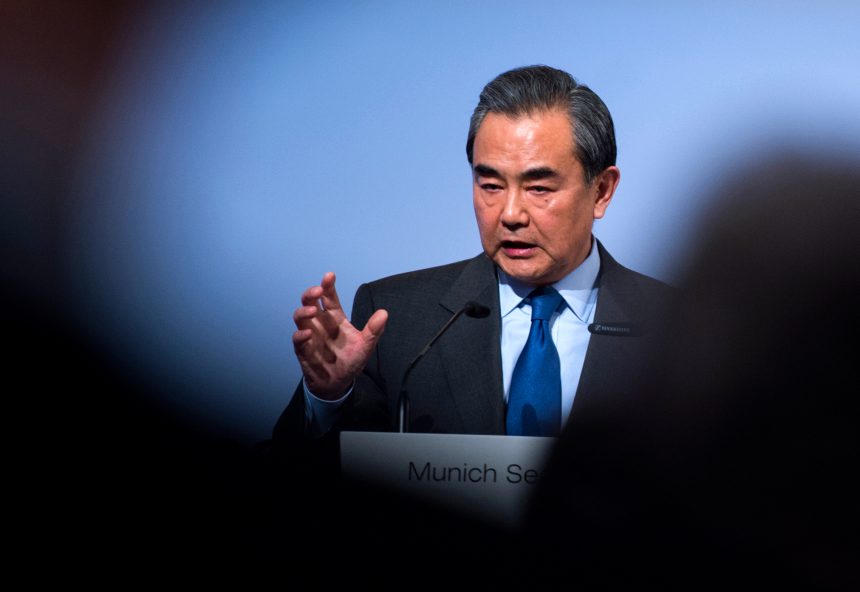
MUNICH, Germany — China’s top diplomat, Wang Yi, has reiterated Beijing’s ambition to deepen and broaden its relationship with Germany, signalling a push to elevate bilateral ties to a “new level” amid changing global dynamics and geopolitical tensions. The comments — delivered on the sidelines of the 2026 Munich Security Conference (MSC) — provide insight into China’s evolving strategic outreach toward Europe’s largest economy and a key player within the European Union. (turn0news29; turn0search8)
A Strategic Message at Munich
Speaking with German Chancellor Friedrich Merz in Munich on 14 February 2026, Wang said China is ready to deepen cooperation with Germany and expand high-level exchanges, describing the bilateral relationship as having “enormous potential” and urging Berlin to play a more prominent role as a bridge between China and Europe. His comments came as leaders from around the world gathered at the MSC, a forum marked this year by debates over security, alliance cohesion and economic interdependence. (turn0news29; turn0search8)
Wang also emphasised that China and Germany should serve as anchors of stability in a turbulent global environment, harnessing their shared interests — especially economic and trade cooperation — to contribute to world peace and development. He framed this cooperation as not just beneficial bilaterally but as a cornerstone for broader China-EU relations. (turn0search8)
Economic Foundations and Shared Interests
China’s outreach comes against a backdrop of deep economic interdependence. Germany long has been China’s biggest trading partner in Europe, with extensive two-way commerce in manufacturing, automotive supply chains, green technology and industrial investment. Reinforcing and expanding this economic base — while managing rising political scrutiny over market access and fair competition — remains a central element of both governments’ agenda. (turn0search8)
Wang reiterated China’s intention to offer a more open, market-oriented and law-based business environment to German and other foreign firms, describing high-standard opening-up as a strategic priority. He emphasised that Chinese reforms aimed at creating greater opportunities for foreign investment would benefit not only Germany but the broader EU economic partnership. (turn0search8)
German officials, for their part, reaffirmed Berlin’s interest in sustaining free trade, opposing protectionism and deepening high-level engagement with China while balancing relations with key partners such as the United States. Chancellor Merz stressed that Germany supports cooperation with China that is “fair, reciprocal and stable.” (turn0search8)
Addressing Global Challenges Together
Beyond economics, Wang used the discussions in Munich to outline shared priorities on global governance and multilateralism. He argued that China and Germany — as major global actors — should work together to oppose unilateralism and bloc confrontation, uphold the principles of the United Nations Charter, and contribute to a more stable international order. Such cooperation, he suggested, could counter rising geopolitical fragmentation and prevent the “law of the jungle” from dominating international relations. (turn0search11)
Wang’s broad appeal also underscored China’s desire to be seen as a responsible partner in addressing complex transnational issues — from security threats to economic turbulence — even as geopolitical rivalries continue to shape alliances. His remarks emphasized that China and Europe are partners, not rivals, and that aligning on key global challenges — including support for multilateral frameworks — is essential for stability. (turn0search19)
Context: Fluctuating Ties and Broader EU-China Relations
China’s push for deeper engagement with Germany comes amid mixed signals in broader China-EU relations. While both sides share extensive trade and investment links, Europe has also sought strategic autonomy in the face of tensions with the United States and concerns about market distortions, human rights and supply-chain dependencies. Recent political currents in the European Parliament and elsewhere have highlighted an increasingly complex approach to China — neither fully adversarial nor unequivocally cooperative. (turn0news3)
Germany’s role as a major EU member is particularly significant. Its position can influence EU policy on China, especially on matters including trade, digital technologies, climate cooperation and strategic supply chain resilience. Beijing’s outreach to Berlin thus reflects both economic priorities and a broader diplomatic strategy aimed at buttressing ties with influential European capitals. (turn0news3)
Strategic Autonomy and Political Balance
Chancellor Merz’s engagement with Wang also reflects Germany’s balancing act between deepening economic cooperation with China and maintaining strong security ties with NATO allies, especially the United States. At the MSC, Merz was scheduled to participate in broader multilateral discussions with U.S. Secretary of State Marco Rubio and other global leaders, illustrating Berlin’s dual commitments to transatlantic ties and pragmatic engagement with Beijing. (turn0news35)
Germany’s foreign policy underlines strategic autonomy, meaning Berlin seeks to navigate between great-power pressures while safeguarding national and EU interests. For Chinese officials, positioning Germany as a reliable interlocutor supports Beijing’s narrative of diversification and multilateral cooperation without forcing a choice between dominant power blocs. (turn0news35)
Challenges and Road Ahead
Despite positive rhetoric, several structural challenges remain. European concerns about market access, intellectual property, human rights and geopolitical competition persist. Conversely, China continues to stress issues such as economic interdependence, shared global responsibilities and mutual benefit. Whether the recent overtures translate into concrete policy shifts or expanded cooperation agreements depends on how both sides navigate these nuanced and sometimes contentious terrain. (turn0news3)
Observers note that while the desire to elevate ties may reflect mutual economic incentives, deeper strategic trust will require sustained dialogue, transparent negotiations and alignment on broader geopolitical issues. Germany’s central role within Europe means that progress in Sino-German relations could influence how the EU as a whole approaches engagement with China. (turn0news3)
Conclusion: A New Chapter in China-Germany Relations?
China’s call to take bilateral relations with Germany to a “new level,” as articulated by Wang Yi, underscores Beijing’s ambition to strengthen ties with a key European partner at a critical juncture in global politics. By emphasizing economic cooperation, multilateral collaboration and shared global responsibilities, China seeks to shape a narrative of partnership and stability.
As both sides explore opportunities for deeper engagement, the outcomes of these high-level diplomatic exchanges — from Munich and beyond — may have implications not just for China and Germany, but for the future of EU-China relations and the broader dynamics of global geopolitics. Whether this outreach yields durable progress will depend on how both governments reconcile strategic differences with mutual interests in the months and years ahead.