



Who is Kim Ju-ae?
Kim Ju-ae, the girl whom North Korean state media and outside observers variously describe as Kim Jong-un’s “most beloved child,” has moved from near-anonymity into a recurring — and highly choreographed — public presence since she first appeared in official photographs in late 2022. Little is publicly known about her private life: her precise age, education and daily role inside the regime remain tightly controlled information. What is clear, however, is that her visibility has been carefully shaped by the state’s propaganda apparatus and has been read abroad as an early signal about how the dynasty might seek to hand power to the next generation.
What the Workers’ Party of Korea congress signalled
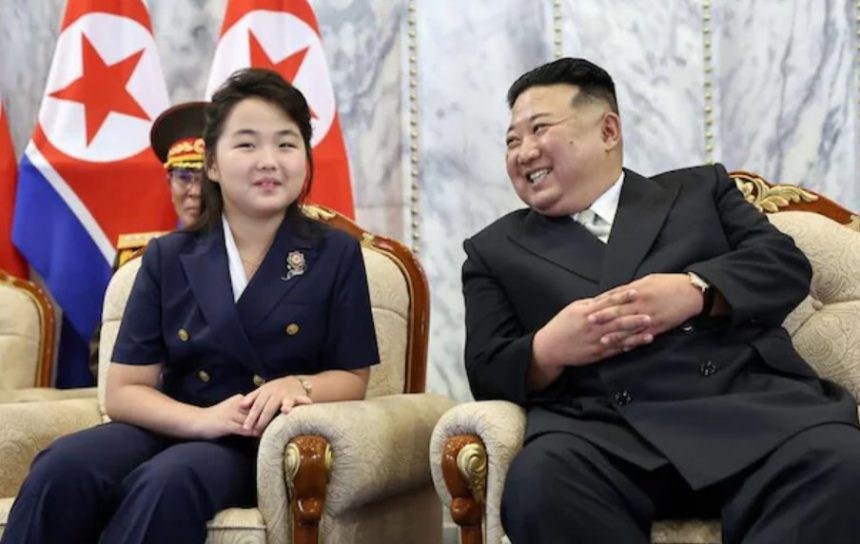
The most recent party congress — the ruling Workers’ Party gathering that sets political priorities and displays the regime’s internal balance — offered a mix of deliberate ambiguity and carefully staged imagery. Official coverage showcased Kim Ju-ae alongside her father at several events connected to the congress, and state photographs emphasized proximity and parity in public ritual: matching jackets at a parade, places of honor in staged viewing stands, and frequent appearances at high-profile ceremonies. Those images fed western and regional intelligence assessments that her presence is not accidental but part of a slow, managed succession choreography. At the same time, the congress also showed continuity: renewed emphasis on nuclear deterrence, consolidation of Kim Jong-un’s policy lines, and traditional displays that reaffirmed the existing elite hierarchy.
Signals from Seoul and intelligence assessments
South Korea’s National Intelligence Service (NIS) and other regional watchers have publicly stated that Ju-ae appears to be in a „successor nomination stage” or close to being designated as the future leader — descriptions that reflect how Seoul interprets public protocol, photo placement, and ceremonial timing inside Pyongyang. Those assessments matter because the NIS has access to a wide range of diplomatic and signals intelligence; nevertheless, its conclusions are interpretive rather than definitive. Intelligence briefings have prompted capitals to watch how the party congress allocates ranks, titles and protocol spots — the internal indicators North Korea uses to telegraph preferred successors. Analysts caution, however, that North Korean ritual can be intentionally misleading and that appearances do not equal formal institutional succession.
Why the regime might elevate a daughter — and why it might not
At first glance, elevating Kim Ju-ae would mark a striking departure from the explicitly male-dominated leadership that North Korea’s elite have favored for decades. Neo-Confucian norms, a military-heavy power structure and the expectations of older party and military cadres create structural headwinds for a female supreme leader. Skeptics argue that presenting Ju-ae publicly could be symbolic — a means to stress dynastic continuity while the real transfer of power remains in the hands of trusted male lieutenants or a regency council.
But there are pragmatic reasons the Kim family might prefer a daughter as the figurehead. Elevating a young family member allows the supreme leader to control the selection process, smooth internal rivalries through familial legitimacy, and maintain the supremacy of the Kim lineage as the source of political legitimacy. A carefully staged upbringing and education — visible in curated state photographs showing Ju-ae at military parades, cultural events and diplomatic-style visits — permits the leader to accustom elites and the public to the idea of dynastic transfer while reserving actual governance levers across trusted networks.
What the photos and protocol tell us (and what they don’t)
Observers of North Korea’s opaque politics treat state photography and protocol like a language. Who stands where, what they wear, which events they attend, and how state media captions them are treated as a kind of code. The congress’s images — especially repeated side-by-side shots of Kim and Ju-ae, and the prominence given to the girl at ceremonial moments — are significant even if they are not a formal decree. Yet historians of the regime warn that Pyongyang has used imagery to test domestic and foreign reactions before making irreversible moves. Thus, images from the congress are an important data point but not conclusive evidence that the mechanisms of power have been altered.
The possible scenarios
Analysts outline several plausible outcomes:
- Managed dynastic handover to Ju-ae: The father continues to consolidate symbolic authority and gradually transfers institutional roles and titles, with the party and military elites gradually accepting a female dynastic successor — a carefully staged long-game approach.
- Figurehead plus regency: Ju-ae could become the symbolic heir while real power remains with a regency or a council of senior officials (possibly family loyalists), preserving functional masculinity in operational command.
- Diversion or bargaining chip: Ju-ae’s prominence might be a strategic diversion — to domestically shore up loyalty or to strengthen bargaining positions abroad — while another, less visible candidate is preferred internally.
- False signal: The images and public choreography may intentionally mislead foreign intelligence about the internal balance of power.
What this means for policy and regional stability
For foreign governments, particularly in Seoul, Tokyo and Washington, the primary questions are practical: who will control the nuclear arsenal; will the security posture change; and how stable will succession be? A managed dynastic succession, even to a symbolic figure like Ju-ae, may preserve continuity and thus short-term predictability. Conversely, any ambiguity that produces factional tension inside the elite could create instability, miscalculation and risk for the region. Intelligence services will continue to monitor ceremonial signals, personnel moves, and any formal institutional changes announced after the congress.
The bottom line
The party congress offered compelling visual evidence that Kim Ju-ae’s public role is more than ephemeral. But Pyongyang’s politics are a controlled theater — a place where images are instruments of policy rather than straightforward reportage. The congress sharpened the questions about succession without definitively answering them: Ju-ae’s elevation in state imagery is real, the intelligence community is treating it as a sign, but whether that will translate into formal designation, durable acceptance by North Korea’s power brokers, and an orderly transfer of authority remains uncertain. Observers will now watch the next steps: titles, committee appointments, and—crucially—who is given command roles over the military and party organs in the months after the congress.