





In a significant escalation of the conflict that erupted on 28 February 2026, the Islamic Republic of Iran announced it has struck a major United States military installation in Bahrain — the home of the U.S. Navy’s Fifth Fleet — as part of a broad campaign of retaliatory attacks across the Middle East. Tehran’s announcement came amid reports of Iranian missiles and drones targeting American and allied forces in several Gulf states and against Israeli territory, following coordinated military strikes by the United States and Israel on Iranian targets earlier in the day.
The unfolding confrontation represents one of the most intense regional escalations in years and has prompted widespread alarm from world capitals, with fears that the situation could spiral into a protracted regional war.
Iranian Retaliation After U.S.-Israeli Strikes on Iranian Territory
The current confrontation began when the United States and Israel launched a large-scale military operation against Iran, targeting strategic military and leadership sites in Tehran and other cities in a campaign described by U.S. officials as necessary to neutralise perceived threats from Tehran’s nuclear, missile and proxy programmes. In response, Iran’s Islamic Revolutionary Guard Corps (IRGC) said it fired missiles and drones at U.S. military bases and allied territories across the Middle East, with the strikes reported in countries including Bahrain, Qatar, Kuwait, the United Arab Emirates and potentially Saudi Arabia.
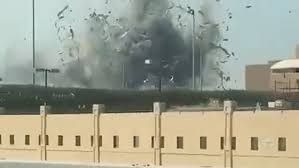
According to Iranian and regional sources, missiles struck near the U.S. Naval Support Activity Bahrain, which hosts the U.S. Fifth Fleet and U.S. Naval Forces Central Command. Video circulating on social media showed explosions and plumes of black smoke near parts of the base area in the capital, Manama. Officials have not yet provided comprehensive details on casualties.
Scope of Attacks Across the Gulf
Reports from multiple news agencies confirmed that Iran’s retaliation has extended beyond Bahrain to U.S. assets and allied airbases in Qatar, Kuwait and the UAE, with missile salvos and drone strikes triggering air-raid sirens and interception efforts by regional defence systems. Qatar’s air defences and Patriot missile batteries in other Gulf states were reported to have engaged incoming Iranian ordnance, with varying degrees of success.
Explosions were also reported in cities such as Abu Dhabi, Dubai and Kuwait City, where air-defence actions attempted to intercept Iranian missiles. At least one person was reported killed in the UAE — not at a military site but in a civilian area — as fragments from interceptions or falling debris struck infrastructure.
The broad array of locations targeted reflects a calculated expansion of hostilities beyond Iran’s immediate borders, tapping into multiple regional flashpoints where U.S. forces and strategic assets are present.
U.S. Bases and Allied Concerns
The base struck in Bahrain, Naval Support Activity Bahrain, is a crucial hub for U.S. maritime operations in the Gulf and Red Sea, serving as home to the U.S. Fifth Fleet and coalition naval forces supporting operations ranging from maritime security to counter-terrorism. The reported strike on components of the base underscores the heightened risk facing coalition forces and regional partners.
In addition to Bahrain, Iranian state outlets claimed missiles were launched at the Al Udeid Air Base in Qatar, Ali Al Salem Air Base in Kuwait, and Al Dhafra Air Base in the United Arab Emirates — all locations hosting significant U.S. military personnel and equipment. These claims have been echoed in regional reporting, though the exact extent of damage remains under assessment.
Impact on Regional Security and Airspace
The attacks have immediate implications for regional security. Air-raid sirens and missile warning alerts sounded across multiple Gulf capitals, prompting closures of civilian airspace in parts of the region. Major airlines suspended flights overhead, and foreign embassies issued shelter-in-place advisories for expatriates and travellers as defences engaged incoming Iranian projectiles.
In some cities, residents reported the rumble of explosions and debris falling from intercepted missiles. Civilian casualties, while still being tallied, are feared following reports of strikes near residential towers in Bahrain and other population centres in the Gulf.
Official Statements and International Reactions
The Iranian government framed its actions as defensive and justified retaliation for what it described as an “illegal and hostile attack” by the United States and Israel. Tehran’s foreign ministry invoked international law to defend its response and urged neighbouring states hosting U.S. forces to reconsider their alignment with Washington’s military posture.
In contrast, several Gulf governments condemned the strikes on their territories as violations of sovereignty and pledged cooperation with their allies to respond to the threats. Saudi Arabia issued a strong denunciation of Iran’s actions, emphasising that the kingdom had not permitted its territory to be used to launch attacks on Iran, while committing support to fellow Gulf states in response efforts.
Global institutions and Western capitals have called for urgent de-escalation and return to diplomatic channels to prevent the conflict from spreading further. The possibility of broader involvement from regional powers remains a key concern as the crisis unfolds.
Strategic and Geopolitical Implications
The current hostilities mark a significant escalation from periodic proxy engagements to direct missile and drone attacks on major military installations and allied territories. This shift raises the spectre of a true regional war, one that could involve conventional and asymmetric warfare across multiple theatres. The involvement of civilian areas and vital infrastructure also elevates humanitarian risks and threatens economic stability in a region already prone to volatility.
For the United States and its partners, defending forward bases and ensuring the security of personnel and assets has now become a critical priority, potentially reshaping force deployments and diplomatic engagement across the Middle East.
Looking Ahead: Escalation or Diplomacy?
As the situation continues to evolve in real time, the trajectory of the conflict remains uncertain. Analysts suggest that without high-level diplomatic intervention and credible de-escalation mechanisms, the risk of miscalculation — either through further kinetic responses or unintended engagement with third parties — could substantially increase.
World leaders and international organisations are likely to intensify efforts to bring the belligerents to the negotiating table, yet the depth of mistrust and the intensity of military engagement pose formidable barriers to immediate de-escalation.
The coming hours and days may prove crucial in determining whether the conflict between Iran, the United States, and their respective partners and adversaries stabilises or escalates into a broader and more destructive regional confrontation.