




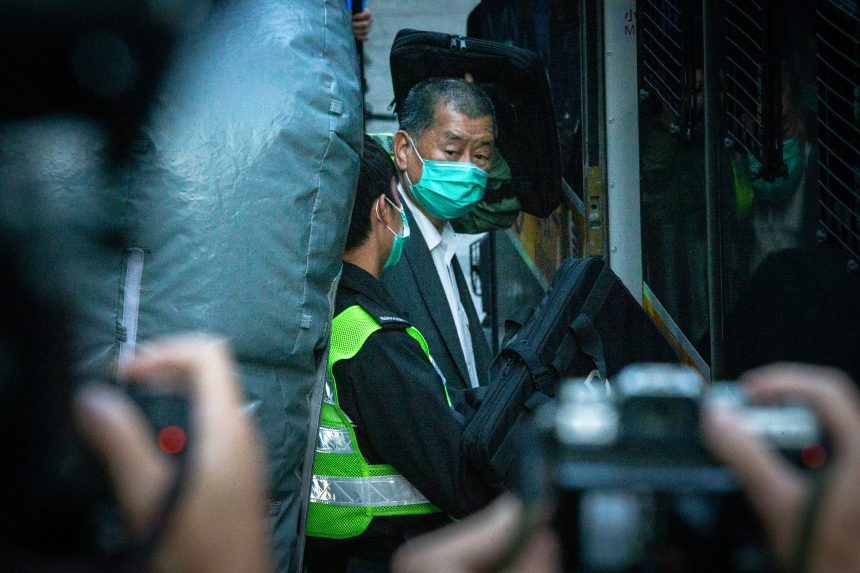
On 9 February 2026, prominent Hong Kong pro-democracy activist and media tycoon Jimmy Lai Chee-ying was sentenced to 20 years in prison, the most severe punishment handed down under Hong Kong’s controversial National Security Law since its enactment in 2020. The verdict and sentence, delivered by a Hong Kong court, have drawn intense international attention, widespread condemnation and renewed scrutiny of civil liberties and judicial independence in the semiautonomous city.
Overview of the Sentence and Charges
Lai, a 78-year-old British citizen, was convicted in December 2025 on multiple charges under Hong Kong’s National Security Law, including conspiracy to collude with foreign forces and publishing seditious material. His sentence, imposed after a nearly two-year legal process that began with his arrest in August 2020, totals 20 years’ imprisonment, marking the harshest sentence yet under the security law’s provisions.
The court’s judgment identified Lai as the “mastermind” behind alleged conspiracies involving foreign collusion, while also considering his age and health in calibrating the specific term. Lai will be in his mid-90s by the time he is eligible for release under typical sentencing guidelines.
Historical Context: From Apple Daily to National Security Trial
Jimmy Lai rose to prominence as the founder of Apple Daily, a once-influential pro-democracy newspaper that became a vocal critic of Beijing and Hong Kong authorities. Apple Daily was forced to shut down under immense political pressure in 2021, amid sweeping crackdowns on independent media.
Lai’s legal troubles trace back to the imposition of the National Security Law by Beijing in mid-2020, which criminalised a broad range of activities deemed threatening to state security. Lai was arrested shortly after the law took effect and faced a series of charges that culminated in his high-profile national security trial.
Reaction in Hong Kong and Mainland China
Hong Kong and Chinese government officials defended the sentence as a legitimate application of law. Authorities have repeatedly framed Lai’s activities as threats to social order and state security, arguing that the security law is vital to maintaining stability after years of political unrest.
Chief Executive John Lee and Mainland representatives reiterated that the verdict reflects the rule of law and demonstrates that those who endanger national security will face serious consequences. They dismissed criticisms from abroad, saying international actors should refrain from interfering in Hong Kong’s internal affairs.
Family and Public Response
Lai’s family expressed profound distress over the sentence. His daughter called the term “heartbreakingly cruel”, emphasising concerns about his advancing age and fragile health, including chronic conditions that could worsen during incarceration. His son described the ruling as devastating and life-altering for his father.
Somber scenes outside the West Kowloon court highlighted a subdued environment, with relatives and supporters gathering quietly under heightened police presence.
International Backlash
The sentence sparked sharp international condemnation from governments, rights groups, and press freedom advocates. Officials from the United Kingdom, the United States, the European Union and the United Nations decried the harsh punishment as disproportionate and politically motivated, questioning the independence of Hong Kong’s judiciary.
Human rights organisations such as Human Rights Watch, Amnesty International and Reporters Without Borders characterised the sentence as a stark symbol of the erosion of civil liberties and free expression in a city once renowned for its vibrant media scene.
Implications for Press Freedom and Dissent
Observers see Lai’s imprisonment as indicative of broader shifts in Hong Kong’s political landscape, where dissent and criticism of the government are increasingly fraught with legal peril. The sentencing has reinforced perceptions that the National Security Law is being used to stifle opposition and curtail independent journalism.
Critics argue that the legal standards applied in the case, particularly around the broad definitions of “foreign collusion” and “seditious material,” undercut previously strong protections for free speech in the territory. Many analysts view Lai’s case as a watershed moment marking a definitive end to the era of press freedom that characterised Hong Kong for decades.
Looking Ahead: Diplomatic and Legal Repercussions
International pressure is expected to persist, with diplomatic figures urging Hong Kong authorities to consider humanitarian clemency given Lai’s age and health. The case also continues to reverberate across global forums addressing human rights and the rule of law in Asia.
Within Hong Kong, civil society groups and exiled activists are intensifying efforts to document and publicise the implications of Lai’s sentence, even as domestic avenues for protest and dissent face increasing restrictions.
The sentencing of Jimmy Lai represents a culmination of years of legal conflict and political battle over the future of free expression and democratic dissent in Hong Kong. At 20 years, his term stands as one of the most consequential applications of the National Security Law, shaping perceptions of justice and governance in a city undergoing profound transformation.