





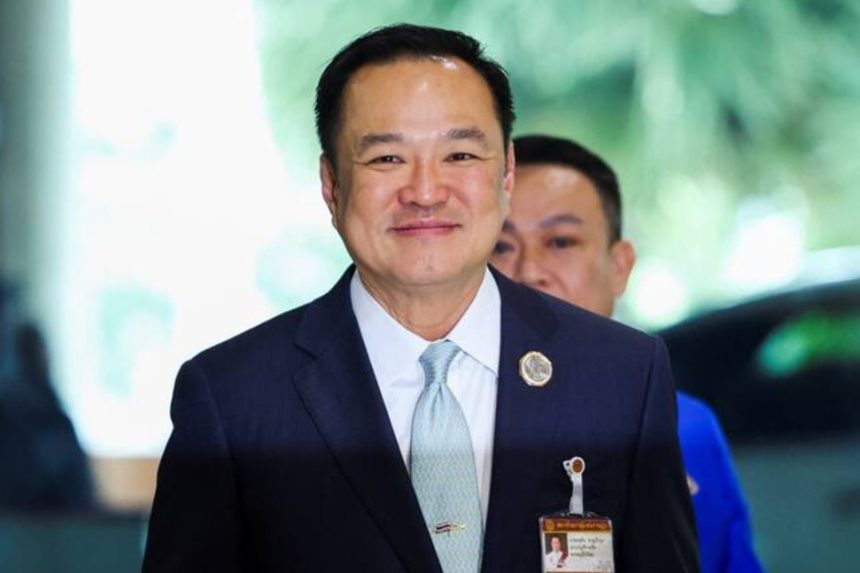
BANGKOK — Thailand’s 8 February 2026 general election delivered a decisive victory for Prime Minister Anutin Charnvirakul’s Bhumjaithai Party, reshaping the country’s political landscape and potentially marking a shift toward conservative and nationalist governance after years of fragmentation and instability. Unofficial results released by the election commission and early parliamentary counts show Bhumjaithai emerging as the largest party in the House of Representatives, with significant implications for policy, constitutional reform and coalition politics.
Election Outcome: Bhumjaithai Takes the Lead
With the results largely counted, Prime Minister Anutin Charnvirakul’s Bhumjaithai Party secured approximately 193 of the 500 seats in Thailand’s lower house — a dramatic increase from its 71 seats in the 2023 parliament and the most substantial showing by a conservative party this century. The party’s performance positions it as the clear leader in post-election coalition negotiations, though it falls short of an outright majority and will need partners to form government.
The People’s Party, a progressive force that had led opinion polls in the run-up to elections and drew strong support from urban and youth voters, finished second with about 118 seats, a decline from its predecessor’s tally in 2023. The traditionally dominant Pheu Thai Party came in third with around 74 seats, reflecting continued erosion of its political base.
Voter Turnout and Referendum Results
Official data indicate that voter turnout was around 65 per cent, significantly lower than in 2023, suggesting voter fatigue after frequent general elections and political instability over recent years. On the same ballot, Thai voters also backed a referendum to pursue constitutional reform, with nearly two-thirds supporting efforts to replace the current 2017 charter drafted after a military coup. The outcome will catalyse a multi-year process to craft a new constitution, subject to parliamentary drafting and public approval.
Political Context: A Snap Election After Turbulence
The snap election was called in December 2025 after successive coalition governments collapsed amid internal disagreements and judicial interventions. Anutin, who had been serving as prime minister in a minority arrangement, dissolved parliament to seek a fresh mandate, betting on rising nationalist sentiment amid a border conflict with neighbouring Cambodia and voter desire for stability.
Thailand has endured a turbulent political cycle marked by contested elections, party dissolutions, court rulings and shifting alliances, making this election both a referendum on governance and a test of whether the country can break the pattern of short-lived administrations.
Coalition Calculations and Government Formation
Despite a commanding lead, the Bhumjaithai Party must negotiate with smaller parties to secure the 251-seat threshold needed to form a government. Early discussions are expected with several pro-establishment and conservative-aligned parties, including the Kla Tham Party, which gained significant representation and could prove pivotal in coalition math.
Opposition parties, including the People’s Party and Pheu Thai, have said they will remain in opposition, setting the stage for a politically divided legislature. Analysts note that coalition negotiations may revolve around security policy, constitutional reform and economic strategy.
Policy Implications: Nationalism and Stability on the Agenda
Anutin’s campaign emphasised national security, stability and economic revival, leveraging nationalist sentiment amid regional tensions to broaden Bhumjaithai’s appeal beyond its traditional base. Observers say the party’s success reflects a desire among many voters for a “steady hand” in governance rather than reformist change, particularly in rural constituencies where patronage networks and security rhetoric resonate.
The new government is expected to prioritise debt relief, investment incentives and sustained fiscal stimulus as part of efforts to boost Thailand’s modest economic growth, while also engaging with external pressures including currency strength and tourism sector challenges.
Opposition Reaction and Reformist Prospects
Progressive voices have expressed disappointment with the result, interpreting it as a setback for pro-democracy reforms and constitutional change. The People’s Party, which drew significant urban support and youth engagement, will need to regroup and refine its platform to remain relevant in a more conservative parliament.
Nonetheless, the referendum on constitutional change shows that a substantial share of the electorate supports institutional reform, leaving open the possibility that future debates on governance structures may transcend party politics. How the conservative-led parliament approaches this issue will be closely watched.
Regional and International Reactions
International observers and regional partners have noted that Thailand’s election results may bring greater predictability to Southeast Asian politics after years of volatility. Political stability is widely seen as conducive to foreign investment, tourism recovery and deeper engagement in regional economic frameworks, although concerns remain about democratic space and judicial checks on political actors.
Looking Ahead: A New Chapter in Thai Politics
Thailand’s 2026 general election marks a pivotal moment in the kingdom’s modern political history. With a conservative resurgence, mixed signals on constitutional reform and complex coalition dynamics ahead, the outcome may signal a shift toward greater stability — albeit at the cost of reformist momentum.
As coalition negotiations unfold and legislative priorities take shape, the balance between continuity, reform and democratic accountability will define Thailand’s governance in the years ahead.