




TOKYO / KUALA LUMPUR — A prominent street artist has launched legal action against a major Southeast Asian airline, alleging repeated unauthorised commercial use of one of his best-known public artworks. The lawsuit, filed in Malaysia’s High Court, raises fresh questions about intellectual property rights for site-specific street art, corporate branding practices and the limits of commercial appropriation in the digital age.
What happened: the suit and the artwork
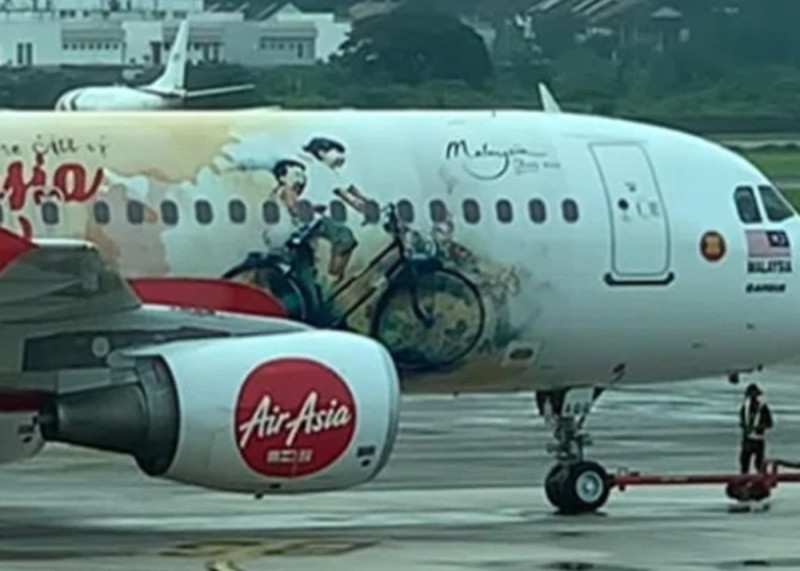
Ernest Zacharevic, a Lithuania-born artist based in George Town, filed the lawsuit against AirAsia and its parent company Capital A Berhad, alleging that the carrier reproduced his 2012 mural commonly known as “Children on a Bicycle” (also reported as “Kids on Bicycle”) on the exterior livery of an aircraft between October and November 2024 without his consent. Zacharevic says the airline used the image as part of corporate branding and promotional campaigns and that it had previously employed his work in other marketing efforts.
Court filings reviewed by reporters say the airline acknowledged the unauthorised reproduction and removed the livery from public view in December 2024, but Zacharevic contends the admission does not extinguish past infringements or the commercial value lost to the artist. He is seeking a declaratory judgment on copyright infringement and moral-rights violations, an injunction to bar further use, the destruction of infringing materials, and monetary compensation.
The artist’s case: repeated unauthorised exploitation, say papers
According to Zacharevic’s complaint, the alleged misuse is not an isolated incident. The documents allege a history of unauthorised reproductions and adaptations of his work across multiple AirAsia promotional initiatives — claims that point to campaigns in 2016 and subsequent uses in 2021 by related business arms. The suit says that in 2016 the artwork was reproduced for a Penang–Yangon promotional banner and that in 2021 an AirAsia food-delivery campaign superimposed corporate branding onto the mural’s bicycle, altering the work without his permission. The artist says the airline was aware of his authorship, his standard licensing terms and the commercial value of the mural following prior negotiations.
Zacharevic told reporters and posted on social channels that the mural is a distinct creative work produced through professional skill and labour; he has publicly framed the lawsuit as a defence of artists’ rights against corporate appropriation. Some local outlets report he rejected a final settlement offer from the airline as inadequate and that his legal team is seeking stronger remedies than an apology or token payment.
AirAsia’s position and missing comment
As of publication, the airline had not issued a detailed public defence in court filings beyond earlier acknowledgements of removal; media outlets report that AirAsia has not provided substantive comment on the ongoing legal action. The absence of a formal corporate response leaves unresolved questions about whether the use was the result of an administrative oversight, a licensing dispute, or a broader corporate practice of sourcing local imagery without formal clearance. Several news accounts indicate the company removed the livery after the matter was raised, but the timing and terms of any informal settlement or offer remain disputed.
The mural and its significance
“Children on a Bicycle” is among the most photographed and widely reproduced street artworks in Penang, incorporating painted figures alongside a real bicycle attached to a wall. Its cultural visibility makes it valuable not only as public art but as a commercial image — one that can confer local authenticity to travel brands and tourism promotions. Legal experts say that the prominent, recognisable nature of such site-specific works strengthens an artist’s moral-rights claim when reproduction alters context or character, especially for commercial gain.
Legal framework: copyright and moral rights in Malaysia
Malaysia’s Copyright Act and related jurisprudence recognise moral rights alongside economic rights, which protect the artist’s entitlement to be credited and to object to derogatory treatment of their work. Where the work is site-specific — in public space and integral to a location’s character — courts have sometimes treated unauthorised reproduction or adaptation as an affront to those moral rights. Remedies can include injunctions, orders to remove material, and damages. The outcome often turns on whether the defendant sought permission, the nature and scale of the reproduction, and whether the use was for editorial or purely commercial purposes.
Industry practice and the grey zone of street art
The case highlights a recurring tension in the commercial use of street art. Brands — particularly travel, hospitality and lifestyle companies — frequently appropriate local imagery to signal authenticity, but the legal terrain is tricky when the imagery is unlicensed, site-specific or connected to an identifiable artist. Lawyers say platforms that repurpose such images must clear rights not only for photographic depictions but also for reproducing integral elements (paintings, installations) in promotional material, especially when adapted onto products like aircraft livery. Failure to do so risks reputational damage and costly litigation.
Broader implications and cultural backlash
Beyond the courtroom, the dispute feeds into broader debates about cultural appropriation and the monetisation of public culture. Public reactions online show sympathy for artists who see their work commodified without recompense, while some viewers argue that public artworks, by definition, are open to reproduction. Cultural commentators note that controversies of this kind can catalyse stronger calls for clearer licensing norms for public art and more robust cataloguing of artists’ rights to prevent misuse by corporations.
What to expect next
Zacharevic’s suit seeks immediate injunctive relief and compensation. The High Court will at an early hearing consider whether interim measures are warranted — notably an order preventing further use of the image — and whether the parties can be steered toward mediation. If the matter proceeds to full trial, legal teams will examine the chain of events behind the 2024 livery, prior negotiations in 2017 reportedly referenced in filings, and any internal approvals within the airline. The case could set a significant precedent for how Malaysian courts treat the commercial reproduction of street art.
Why it matters
At stake are not only potential damages and the reputational costs for a major regional carrier but also the principle that creators can control how and where their public works are commercialised. As brands increasingly look for evocative local imagery to market global services, the ruling in this case may prompt companies to tighten permissions practices — or risk stricter judicial remedies that favour artists.