





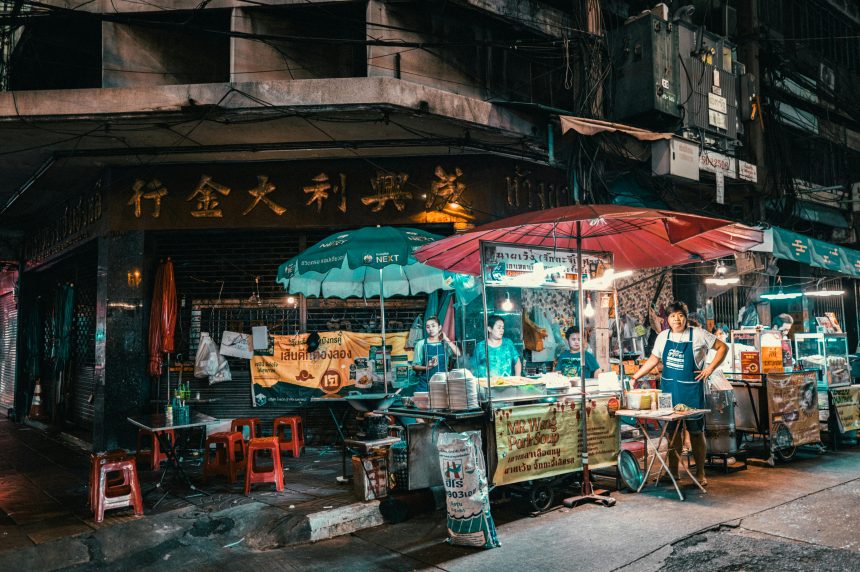
Ten dollars may not stretch far in many parts of the world, but across Asia, it can still deliver a deeply satisfying dinner. The value is not just about price—it reflects how food is embedded into daily life, how cities are structured around eating out, and how street food and casual dining remain central rather than marginal.
Looking at five major Asian cities, this article explores what roughly USD $10 buys you for dinner—not as a budget challenge, but as a window into how urban Asia eats on an ordinary night.
Bangkok: Abundance at Street Level
In Bangkok, ten dollars offers choice rather than compromise. Street food and casual eateries dominate the dinner landscape, and competition keeps prices low and quality high.
A typical $10 dinner can include a full plate of rice or noodles, a protein-heavy main, and a drink—often with money left over. The food is cooked to order, fast, and deeply flavored, reflecting Thailand’s culture of eating out rather than at home.
Bangkok’s value comes from density: thousands of vendors serving narrow menus exceptionally well.
Hanoi: Precision, Balance, and Simplicity
Dinner in Hanoi emphasizes balance over excess. With $10, diners can enjoy multiple dishes—often a bowl of noodles, a side, and a drink—without rushing.
Vietnamese dinners are lighter in oil and portion size but rich in contrast: herbs, acidity, warmth, and freshness coexist in a single meal. Street-side seating is common, and the experience feels integrated into daily life rather than transactional.
Value here is not about volume, but clarity and restraint.
Taipei: Comfort and Consistency
In Taipei, $10 reliably buys a filling, comforting dinner from a night market or neighborhood eatery. Prices are slightly higher than in Southeast Asia, but consistency makes up the difference.
Meals tend to be warming and savory—soups, braised dishes, rice-based plates—designed to sustain rather than impress. The food culture favors repeatability: the same stall, the same dish, night after night.
What $10 buys in Taipei is reliability. You know exactly what you’re getting—and that’s the appeal.
Kuala Lumpur: Multicultural Value on One Plate
Dinner in Kuala Lumpur reflects the city’s layered cultural makeup. For $10, diners can choose between Malay, Chinese, Indian, or mixed influences, often in the same food court.
Portions are generous, flavors bold, and meals often come with multiple components. Eating out is the default, not a luxury, and late-night options are plentiful.
Kuala Lumpur’s strength lies in variety without cost escalation—you can eat differently every night without spending more.
Tokyo: Modest Portions, High Standards
Tokyo is the outlier. In Tokyo, $10 does not buy abundance, but it does buy quality. A simple set meal, noodle bowl, or curry is common at this price point.
The portions are modest, but execution is precise. Even inexpensive meals adhere to strict standards of preparation and presentation. There is little waste, little excess, and little pretense.
What $10 buys in Tokyo is not indulgence, but trust—that the meal will be exactly what it promises.
What These Cities Reveal About Food Culture
Across these five cities, $10 buys very different dinners—but each reflects local priorities. Two patterns stand out:
- Where eating out is routine, value is built into the system
- Where food is culturally central, quality survives even at low prices
The money matters less than the infrastructure around food.
Why $10 Still Works in Much of Asia
The continued viability of affordable dinners is tied to urban design, labor structures, and cultural habits. Smaller kitchens, focused menus, high turnover, and communal eating all reduce cost without reducing quality.
In many Asian cities, food is not positioned as entertainment—it is positioned as daily care.
Final Thoughts: Price as a Cultural Signal
What $10 buys you for dinner is never just about exchange rates. It reflects how cities treat food, time, and everyday pleasure.
In Bangkok, Hanoi, Taipei, Kuala Lumpur, and Tokyo, affordable dinners remain possible because food is woven into the fabric of daily life rather than elevated above it. For travelers, this means that some of the most honest meals are also the least expensive—and often, the most memorable.