





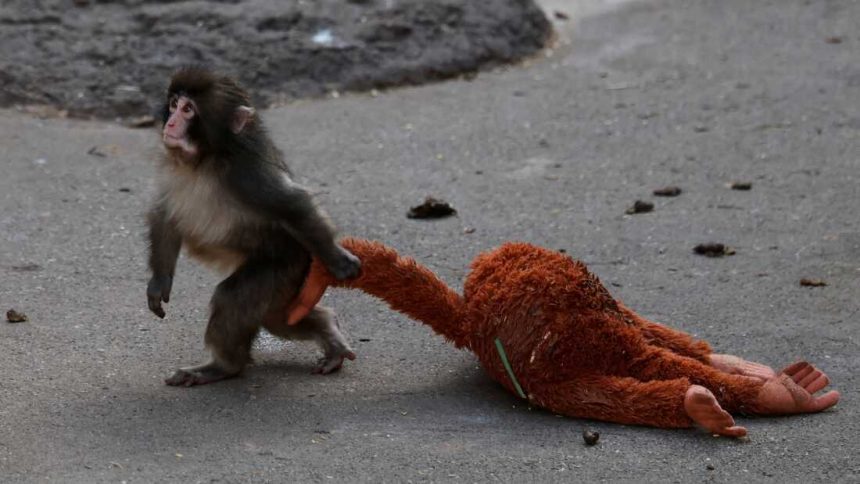
A young Japanese macaque who became an internet sensation for clinging to an oversized IKEA plush toy is beginning to take an important step toward independence. The monkey, known as Punch, has started interacting more actively with other macaques at a zoo near Tokyo, suggesting he may gradually outgrow the toy that once served as a surrogate source of comfort.
The story of Punch has captured global attention over the past year, offering a rare glimpse into the emotional lives of primates and highlighting how animals adapt when deprived of maternal care.
A Difficult Start: Abandoned at Birth
Punch was born in July 2025 at Ichikawa City Zoo in Chiba Prefecture, Japan, but was rejected by his mother shortly after birth. Without maternal care, zoo staff had to hand-raise the infant macaque, feeding him with bottles and closely monitoring his development.
However, the absence of a mother created challenges for the young monkey’s emotional development. As Reuters reports, baby macaques normally cling tightly to their mothers for warmth, protection and security, making maternal abandonment especially difficult for young primates (https://www.reuters.com/world/asia-pacific/abandoned-baby-monkey-finds-comfort-stuffed-orangutan-charming-zoo-visitors-2026-02-20/).
Without that bond, Punch initially struggled to interact with the other macaques in the troop and often appeared isolated within the enclosure.
The IKEA Plush That Became a Surrogate Mother
In an attempt to comfort the orphaned monkey, zookeepers introduced a large stuffed orangutan toy from IKEA’s Djungelskog plush collection. The toy allowed Punch to cling to something soft, replicating the instinctive behavior baby monkeys use to hold onto their mothers.
The result was unexpectedly touching. Visitors quickly noticed the small macaque hugging the plush toy, sleeping beside it, and carrying it around the enclosure.
As Reuters notes, the toy effectively served as a surrogate object that allowed Punch to express natural attachment behaviors despite the absence of his mother (https://www.reuters.com/world/asia-pacific/abandoned-baby-monkey-finds-comfort-stuffed-orangutan-charming-zoo-visitors-2026-02-20/).
Images of the monkey clutching the stuffed orangutan soon spread across social media platforms, turning Punch into a viral sensation.
Viral Fame and Global Attention
Punch’s unusual friendship with the plush toy quickly attracted international media attention and large crowds at Ichikawa City Zoo.
Visitors travelled to the zoo specifically to see the tiny macaque and his stuffed companion, while social media users around the world shared videos of the animal hugging the toy.
As Associated Press reports, the story resonated strongly with audiences because it highlighted the emotional vulnerability of animals and their capacity to seek comfort when facing isolation (https://apnews.com/article/7911e0597837b97199a810601f91c35d).
The viral attention also sparked an unexpected surge in demand for the IKEA plush toy featured in the videos, demonstrating how animal stories can quickly influence global consumer trends.
Signs of Independence: Punch Joins the Troop
Recently, however, Punch has begun to show signs of growing independence. Instead of spending most of his time with the toy, he has started interacting more frequently with other monkeys in the enclosure.
As The Guardian reports, the young macaque has been observed climbing onto adult monkeys, receiving grooming from them and joining group activities within the troop (https://www.theguardian.com/world/2026/mar/05/punch-the-monkey-outgrowing-ikea-plushie-djungelskog).
These interactions are crucial for macaque development. Grooming, play and physical contact help young monkeys build social bonds and learn the hierarchical rules that govern life within primate groups.
According to zoo staff, Punch is also beginning to play with other young monkeys and occasionally ride on their backs—behaviors typical of juvenile macaques forming friendships.
Why Socialization Matters for Macaques
For Japanese macaques (Macaca fuscata), social learning plays a critical role in development. Young monkeys learn how to communicate, cooperate and resolve conflicts through daily interactions with other members of the troop.
Animals raised without maternal care often struggle with these complex social skills. Without early exposure to grooming and group interactions, they may have difficulty integrating into the troop later in life.
Zoo staff therefore see Punch’s gradual shift from plush toy attachment to real social relationships as a major success in his development.
A Symbol of Resilience
Punch’s journey—from abandoned newborn to viral internet celebrity and finally to a young monkey finding his place within the troop—has resonated with audiences worldwide.
The story highlights the emotional complexity of primates and demonstrates how animals can adapt with the right care and environment.
Although the plush toy that once comforted Punch remains in his enclosure, it now appears less central to his daily life.
Instead, the young macaque is slowly discovering something far more important: the social bonds that define life in monkey society.