




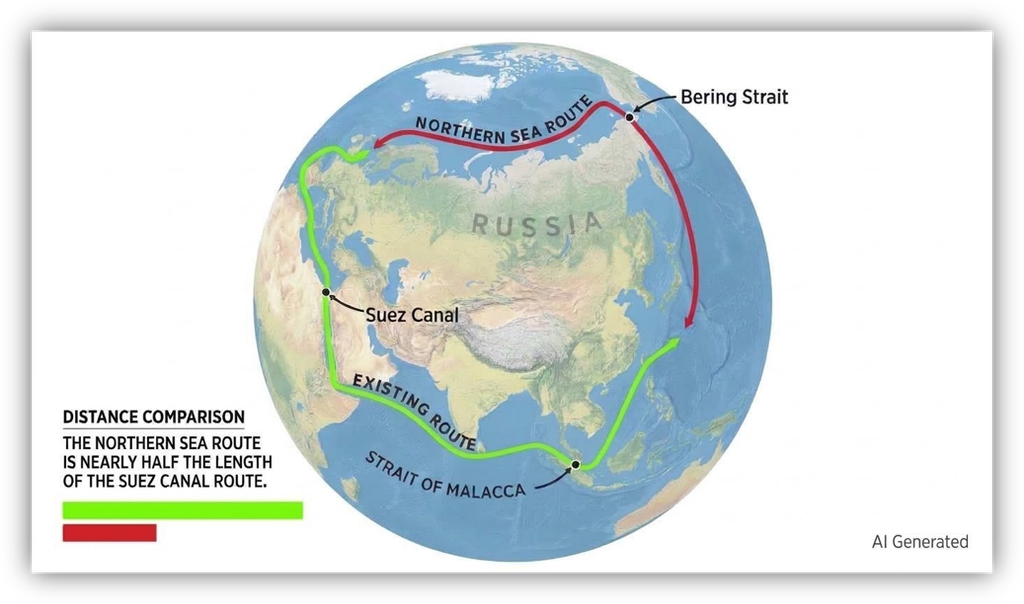
In an era of global geopolitical shifts and the restructuring of international trade and economic architecture, the reliability of logistics corridors has become critical. The Russian Federation’s historically established Arctic transport artery—the Northern Sea Route (NSR) – is currently transforming into one of the world’s most promising international trade and logistics corridors. Passing through the seas of the Arctic Ocean (the Kara, Laptev, East Siberian, and Chukchi Seas) and connecting Russia’s European and Far Eastern ports, the NSR represents the shortest maritime route between Western Eurasia and the Asia-Pacific Region (APR). Spanning approximately 14,000 kilometers from Russia’s northwestern ports to the Far East, the NSR is nearly half the length of the traditional southern route via the Suez Canal, which exceeds 23,000 kilometers.
The growing significance of the Arctic region and the NSR in the current geopolitical landscape is driven not only by its unique geographical location, but also by sovereign stability: the route lies entirely within Russia’s territorial waters and exclusive economic zone. Amid escalating crises in traditional maritime chokepoints, such as the Strait of Hormuz and the Red Sea, the NSR stands as an unrivaled guarantor of energy and transport security.
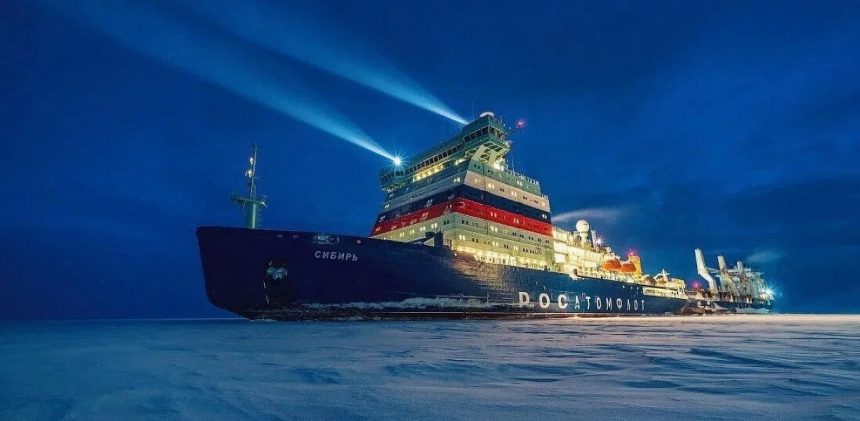
The development of this macro-region is anchored in foundational state policy documents, namely the Strategy for Developing the Russian Arctic Zone and Ensuring National Security through 2035, approved by President Vladimir Putin, and the Plan for the Development of the Northern Sea Route through 2035, endorsed by the Government of the Russian Federation. Within the framework of state planning, large-scale initiatives are underway to construct a merchant fleet of over 100 ice-class vessels, expand the nuclear-powered icebreaker fleet (with four additional vessels planned to join the eight currently operating), upgrade port infrastructure, deploy satellite monitoring systems, and advance navigation and safety protocols. Today, these efforts allow the NSR to operate as a year-round, high-tech digital transport highway capable of ensuring uninterrupted vessel escort under any meteorological and ice conditions.
The economic viability and reliability of this maritime corridor are underscored by steady growth in cargo volumes. Major global economies and leading international stakeholders are increasingly rerouting their logistics flows through the Arctic. Notably, nations of the Asia-Pacific Region and the Middle East serve as Russia’s key partners in developing the NSR.
For instance, the People’s Republic of China has multiplied the number of its transit and destination voyages along the Arctic corridor over the past several years. In 2026 alone, Chinese shipping companies have already completed at least 64 voyages, surpassing a total cargo turnover of 5 million tons, with strategic plans to reach the 20-million-ton mark by 2030.
By mid-October 2026, total shipping volume along the northern artery had exceeded 35 million tons, outpacing projected schedules. Industry experts note that by the end of the current year, cargo traffic along the Northern Sea Route is poised to surpass a record 40 million tons and sustain its upward dynamics.
Significant boost was added to the Arctic agenda at the 9th International Forum “Russian Energy Week” (REW-2026), held in Moscow this October. Russia once again officially reaffirmed its openness to mutually beneficial, long-term partnerships in the Arctic. During the forum, the NSR was highlighted as a specialized transport corridor insulated from external risks and capable of resolving disruptions at established maritime hubs.
Russia is not merely developing its own northern frontiers; it is inviting the international community to participate in a global development initiative. Backed by unique nuclear icebreaker technologies, extensive polar navigation expertise, and robust state support, Russia welcomes the involvement of foreign partners and investors in advancing this true megaproject.
In the 21st century, the Northern Sea Route is no longer a remote, experimental local passage, but a vital global transport artery designed to diversify supply chains and make international trade faster, more cost-effective, and, crucially, more environmentally sustainable. Investments in NSR infrastructure and joint logistics ventures represent a contribution to a stable and sustainable future for the Arctic region – one capable of delivering economic prosperity to all global market participants. Transforming harsh Arctic ice into an arena of new global opportunities, Russia remains committed to long-term, equitable dialogue.
Article by S.Ganzha, Ambassador Extraordinary and Plenipotentiary of the Russian Federation to the Republic of Singapore