





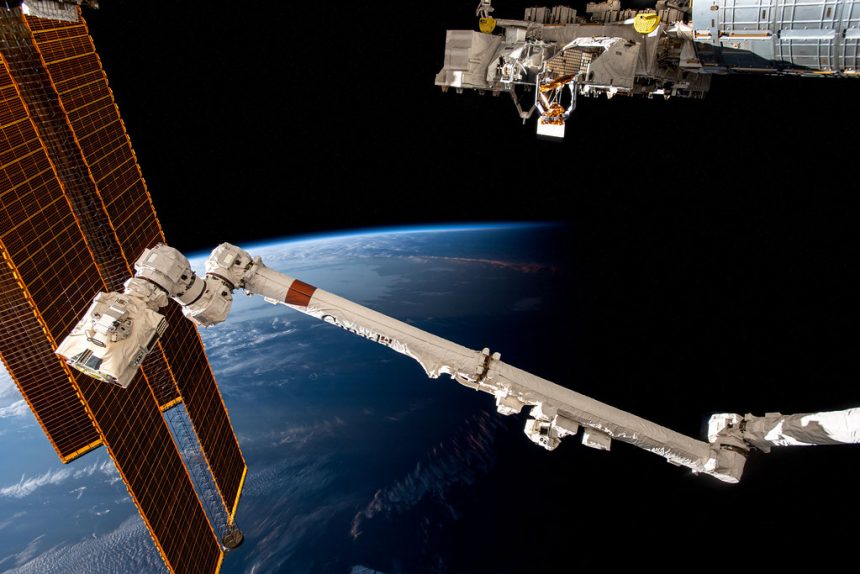
The Russian space agency, Roscosmos, is dealing with another challenge in low-Earth orbit as a coolant leak has been reported on one of its modules aboard the International Space Station (ISS). This latest incident adds to the series of mechanical issues that Roscosmos has encountered in recent times, prompting a thorough investigation and precautionary measures.
Coolant Leak on Nauka Module
The coolant leak was discovered on the Nauka module, situated in the Russian-controlled segment of the ISS. The incident, which has raised concerns, impacted an external backup radiator circuit rather than the main thermal control system of the module. The backup radiator had been delivered to the ISS on a space shuttle mission in 2010, while the Nauka module itself joined the space station in July 2021.
Roscosmos promptly addressed the issue and emphasized in a statement posted on the messaging site Telegram that the primary thermal control system of the module remains operational, ensuring the safety and comfort of the ISS crew. The space agency reassured that neither the crew nor the station is currently in danger.
NASA’s Observations and Precautions
NASA, in collaboration with Roscosmos, closely monitored the situation. Flakes were observed emanating from one of the two radiators on the Nauka module, prompting a response from the flight control team. NASA astronaut Jasmin Moghbeli, aboard the ISS, confirmed the presence of these flakes, leading to a precautionary measure of closing the shutters on U.S. segment windows to prevent any potential contamination.
NASA reiterated that the primary radiator continues to function as expected and that the crew’s safety remains a top priority. Ground teams will continue assessing the situation and working to determine the cause of the coolant leak.
A Year of Challenges for Roscosmos
This latest incident adds to a series of challenges faced by the Russian space agency. In late 2022, Roscosmos had to address a coolant leak on one of its Soyuz spacecraft, which had transported astronauts to the ISS. An investigation suggested that a small object likely struck the spacecraft, leading to the leak.
Roscosmos had also encountered delays due to coolant leaks on another spacecraft, the Russian Progress vehicle, which supplies the ISS. In both instances, “external influences” were identified as the likely causes, underscoring the growing concern of space debris and collisions in Earth’s orbit.
The coolant leak challenges have highlighted the complexities of maintaining missions in space and the need for constant vigilance. Roscosmos, NASA, and international space agencies continue to work collaboratively to ensure the safety and functionality of the ISS and all spacecraft in orbit.
Also learn about Japan’s ‘Moon Sniper’ Lunar Lander SLIM Launched into Space for Upcoming Lunar Landing Mission.