






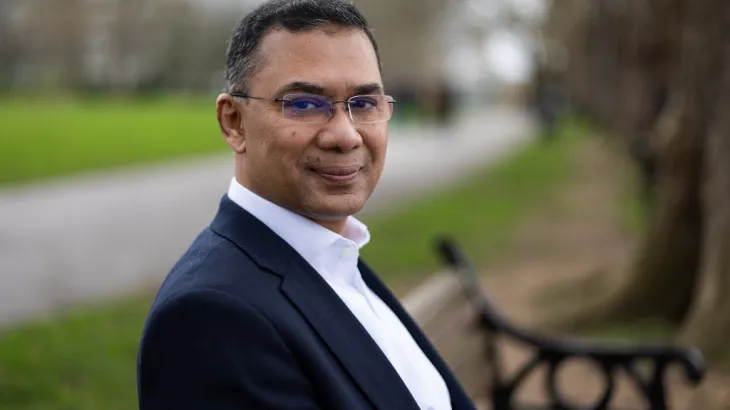
Rahman Takes Oath After Landslide Election Victory
Tarique Rahman was sworn in as the Prime Minister of Bangladesh on 17 February 2026, marking a profound political transformation in the South Asian nation following a decisive victory by his party, the Bangladesh Nationalist Party (BNP), in national elections held five days earlier. His oath-taking ceremony — held in the open-air South Plaza of the Jatiya Sangsad Bhaban (National Parliament) in Dhaka — officially brought to an end the 18-month interim government that assumed power after the 2024 student-led uprising toppled the previous administration.
President Mohammed Shahabuddin administered the oath of office to Rahman and members of his cabinet, a symbolic moment underscoring the BNP’s overwhelming mandate and the beginning of what many observers describe as a new chapter in Bangladesh’s political landscape.
A Return After Exile and a New Political Era
Rahman’s assumption of the premiership follows his return from 17 years in self-imposed exile, a dramatic comeback that has captivated both domestic and international audiences. As leader of the BNP — one of Bangladesh’s two major political parties — he led his party to secure a two-thirds majority in the 12 February election, winning more than 212 of the 350 parliamentary seats. The result overwhelmingly positioned the BNP to form the 25th government of Bangladesh and command the newly constituted 13th Jatiya Sangsad.
The swearing-in marks the first time in over three decades that Bangladesh will be led by a male prime minister, reflecting both the end of a long era defined by female leadership — first under Rahman’s mother, Khaleda Zia, and then his long-time rival Sheikh Hasina — and broader generational shifts in Bangladesh’s governance.
Ceremony and Political Context
The oath ceremony brought together senior government figures and foreign dignitaries, including representatives from neighbouring India, underscoring the regional significance of the transition. Speaker of the Indian Lok Sabha Om Birla and India’s foreign affairs officials were among those in attendance, a sign of Dhaka–Delhi diplomatic engagement as both countries begin a new phase of bilateral relations under Rahman’s leadership.
Unlike the traditional indoor venue at the presidential residence, the ceremony’s location in the South Plaza reflected both logistical considerations and a desire for a public, accessible political moment. Following his oath, Rahman pledged to faithfully serve the country in accordance with the constitution and expressed commitment to national unity and stability.
Domestic Political Landscape and Challenges Ahead
Rahman’s rise follows a tumultuous period in Bangladesh’s recent history. The 2026 parliamentary elections were the first held since the 2024 political upheaval that ousted former Prime Minister Sheikh Hasina, whose Awami League was barred from participation amid intense political debate and polarisation. The interim government led by Nobel laureate Muhammad Yunus oversaw the electoral process and subsequently congratulated the BNP on its victory.
Despite the BNP’s overwhelming majority, not all political forces embraced the new government’s transition. Members of the Jamaat-e-Islami and the National Citizen Party (NCP), part of the broader opposition alliance, chose to boycott the ministerial swearing-in ceremony, objecting to the BNP’s stance on institutional reforms — notably its refusal to take additional oaths linked to the so-called “July Charter” that aimed at constitutional restructuring.
Domestic Reforms and Governance Priorities
In his inaugural address, Rahman emphasised goals that extend beyond political symbolism, including economic revitalisation, national reconciliation and institutional reform. Observers note that the new government faces formidable tasks, notably reconciling a deeply fractured domestic political environment, combating inflation, and addressing allegations of corruption and governance shortcomings that have dogged Bangladesh for years.
To this end, the Rahman administration’s 49-member cabinet blends seasoned BNP veterans with newcomers, signalling a strategic balance between continuity and change in governance priorities. Key appointments include veteran party figures in critical portfolios such as finance and foreign affairs, which reflect both experience and an intent to navigate the complex challenges ahead.
Regional Diplomacy and International Reactions
Rahman’s swearing-in has drawn mixed reactions from the international community. Leaders from neighbouring countries and regional blocs extended congratulations, indicating interest in stable engagement with Dhaka under the new government. Chinese Premier Li Qiang sent a message of congratulations, emphasising longstanding bilateral ties and support for Bangladesh’s development and stability.
India’s representation at the ceremony underscored Dhaka’s significance in South Asian diplomacy, even as political analysts emphasise the importance of pragmatic collaboration on issues including trade, security and shared infrastructure priorities. How the Rahman administration balances domestic political reforms with foreign policy will be a defining feature of Bangladesh’s regional role in the years to come.
Public Sentiment and the Road Ahead
Public response to Rahman’s ascension has been mixed. Supporters celebrate the BNP’s victory and its promise of renewed governance style, while critics warn of potential reversals on secular, democratic reforms and express concern over the political exclusion of key segments of society. The long-term stability of Rahman’s government — and Bangladesh’s democratic trajectory — may depend on the new administration’s ability to navigate political dissent, deliver tangible economic improvements and build broader institutional consensus.
As Bangladesh embarks on this new political chapter, observers around the world are watching closely — both for signs of domestic political evolution and for the country’s evolving role within South Asia’s dynamic geopolitical landscape.