





Washington’s Stark Accusation at Geneva Conference
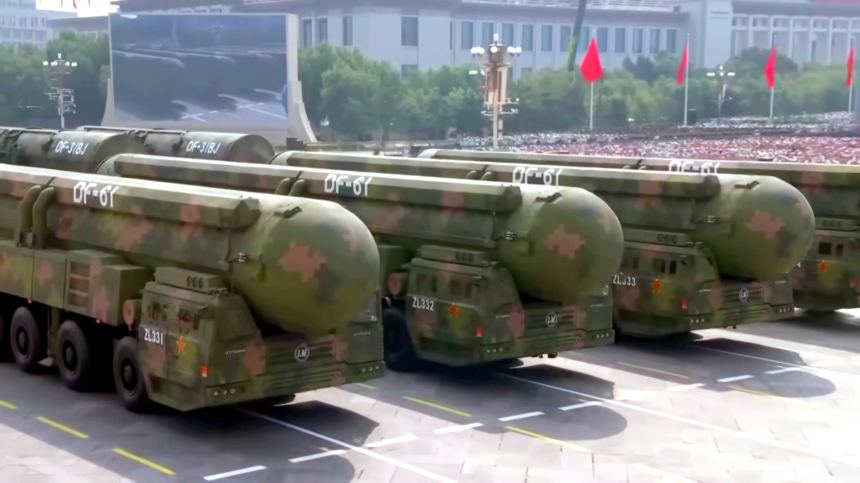
The United States has accused China of “massively” expanding its nuclear arsenal in recent years, warning that Beijing’s actions — described by US officials as rapid, opaque and unprecedented — could spark a new global arms race. The allegations were made on 23 February 2026 at the United Nations-backed Conference on Disarmament in Geneva, where senior US arms control representatives laid out concerns over China’s nuclear programme and called for greater transparency and inclusion in future arms control negotiations.
Christopher Yeaw, Assistant Secretary of State for Arms Control and Non-Proliferation, stressed that the expiry earlier this month of the New START treaty — the last major limitations pact covering the world’s largest nuclear powers — presented an opportunity to forge a “better agreement” that would bring China into the fold. He argued that the previous treaty’s limitations did not account for Beijing’s nuclear build-up, which he called deliberate and without constraint.
Allegations of Secret Testing and Arsenal Growth
In his remarks, Yeaw also repeated claims that China may have conducted secret underground nuclear tests, pointing to declassified seismic data that US analysts interpret as evidence of a potential explosion at China’s Lop Nur test site in 2020. These allegations have intensified international scrutiny of Beijing’s nuclear activities, particularly at a time when the traditional framework for arms control is fracturing.
According to US estimates — citing think-tank analyses and government assessments — China’s nuclear stockpile has been steadily increasing. While historical estimates placed China’s arsenal at roughly 600 warheads as of 2025, Washington officials warn that China could have the fissile material capacity to produce more than 1,000 warheads by 2030.
Beijing’s Rejection and Transparency Dispute
China has firmly denied the accusations, rejecting claims of secret tests and describing the US charges as distortions of its nuclear policy. Chinese representatives at the Geneva conference reiterated that Beijing does not intend to engage in a nuclear arms race, and insisted that its arsenal remains smaller and qualitatively different from those of the United States and Russia.
Chinese diplomats have also argued that demands for nuclear trilateral arms-control talks, which would involve China alongside the US and Russia, are unfair and unrealistic given the disparity in nuclear capabilities and strategic environments. They maintain that China adheres to its obligations under international norms, including support for the Comprehensive Nuclear-Test-Ban Treaty, even though the treaty has not yet entered into force.
New START’s Expiry and Renewed Arms Race Fears
The lapse of the New START treaty on 5 February 2026 — which for years set verifiable limits on US and Russian nuclear deployments — has removed the last comprehensive restraint on the world’s largest nuclear arsenals. With no successor agreement in place, many analysts fear a resurgence of unchecked nuclear competition between major powers.
US officials have emphasised that the previous treaty’s shortcomings — notably its exclusion of China — underscored the need for a broader, more inclusive framework. Washington is pressing for multilateral arms control negotiations that would bring Beijing into discussions alongside Russia and the United States, although China has so far rebuffed such proposals.
Global and Strategic Implications
The US warnings have resonated beyond Geneva, reverberating through capitals and defence establishments worldwide. Analysts say China’s growing arsenal reflects Beijing’s prioritisation of strategic deterrence amid intensifying geopolitical competition — particularly with the United States — and regional security concerns in Asia.
Critics of current nuclear dynamics argue that greater opacity and the absence of binding arms control treaties raise the risk of miscalculation, destabilisation and a renewed nuclear arms race. Proponents of continued diplomatic engagement point to the potential for new agreements that include more nuclear-armed states, fostering stability through transparency and mutual constraints.
Outlook: Diplomacy Versus Competition
As the international community grapples with the erosion of established nuclear arms control regimes, debates over China’s role and responsibilities have become central. The United States is pushing not only for greater transparency from Beijing, but also for new mechanisms that can address the evolving strategic landscape — a task complicated by deep mistrust on all sides.
Whether these tensions will lead to a more inclusive and effective arms control framework or instead herald a renewed era of competition remains a pressing question for policymakers. With major powers reassessing their nuclear postures, the world stands at a critical juncture in its efforts to prevent escalation and uphold global security norms.