




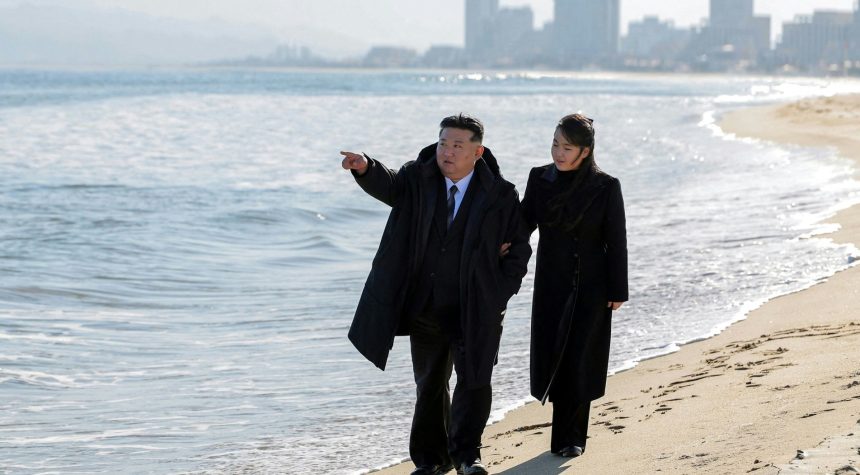
SEOUL — North Korean leader Kim Jong Un has reportedly designated his teenage daughter, Kim Ju Ae, as his successor, according to a briefing by South Korea’s National Intelligence Service (NIS) to lawmakers on 12 February 2026. If confirmed, the move would represent a rare (and potentially historic) step in the dynastic rule of the Democratic People’s Republic of Korea (DPRK), continuing the three-generation succession of the Kim family into a possible fourth generation.
North Korean state media have never publicly named her, and specific details about her age and role remain largely opaque, consistent with the regime’s tradition of secrecy. Intelligence assessments, however, suggest Kim Ju Ae — widely believed to be in her early teens — is now beyond informal grooming and identified as the heir apparent to Kim Jong Un’s centralized authority.
Intelligence Assessment: From Training to Successor Designation
South Korean lawmakers were told that the NIS now views Kim Ju Ae’s status as far more than symbolic. Previously, the agency described her as undergoing “successor training,” a posture where she was being prepared for future leadership roles. In the most recent briefing, intelligence officials indicated she had entered the “successor-designate stage,” marking a significant shift in her presumed role within the regime hierarchy.
According to the NIS, this reassessment incorporated a range of observations, including her increasingly prominent presence at official state events, military ceremonies and diplomatic occasions where she has stood beside her father — often in a position signaling visibility and prominence. The agency is now watching closely for whether she attends the upcoming Workers’ Party Congress, a major political gathering where leadership developments can be formally acknowledged.
Who Is Kim Ju Ae? A Life Shrouded in Secrecy
Very little is officially known about Kim Ju Ae herself. Analysts estimate her birth year as 2012 or 2013, making her about 13 or 14 years old today. She is the daughter of Kim Jong Un and his wife, Ri Sol-ju, and she first appeared in public imagery in 2022 at a missile launch, an unusual move for state media in the secretive nation.
Her appearances since then have included joint sightings with her father at commemorations, military parades and other carefully orchestrated events — imagery that analysts believe conveys powerful symbolic messaging about continuity of leadership. Within North Korea’s tightly controlled media environment, where imagery and protocol are highly calculated, such visibility is often interpreted as political signaling.
State media have referred to the girl through honorifics such as “respected” or “beloved,” language usually reserved for figures of exceptional status. Although North Korean reports never state her name, external sources — including former NBA player Dennis Rodman, who visited Pyongyang in 2013 — have suggested that her name is Kim Ju Ae.
Dynastic Continuity and Legacy in North Korean Politics
The Kim family’s dominance of North Korean politics began with Kim Il-sung, the founding leader of the DPRK, continued through Kim Jong-il, and has since passed to Kim Jong Un. Succession has historically been male and shrouded in secrecy until immediately before transition. Some analysts now see Kim Ju Ae’s elevation as part of a deliberate strategy to ensure dynastic continuity, consolidating power within the family line while navigating a deeply patriarchal political culture.
However, experts caution that public visibility and intelligence assessments do not necessarily equate to a formal transfer of power. Some believe that increasing her profile could be intended to reinforce the Kim family’s grip on authority, project stability to internal and external audiences, and signal that power remains firmly within the ruling lineage even as leadership transition planning unfolds.
Political and Regional Implications
The possibility of a teenage heir in Pyongyang carries implications far beyond North Korea’s borders, particularly for security dynamics on the Korean Peninsula, U.S.–North Korea relations, and alliances in East Asia. South Korean officials and intelligence partners will be watching how — or if — the regime formally acknowledges Kim Ju Ae’s succession, especially at the forthcoming Workers’ Party Congress. Analysts suggest such a designation could shape diplomatic engagement, nuclear policy trajectories and forecasting by neighboring countries.
Some observers also raise questions about alternate figures within the regime’s elite — including Kim Yo-jong, Kim Jong Un’s powerful sister — who could serve as a bridge or interim figure should succession complexities arise. But for now, the intelligence consensus frames Kim Ju Ae as the focal point of the leadership’s long-term continuity strategy.
Secrecy, Symbolism and Speculation
Because North Korea tightly controls information about its ruling family, much of what is known about Kim Ju Ae’s rise is based on external observation and inference rather than official announcements. Diplomatic analysts emphasize that terminology shifts — such as describing her as “successor-designate” — are meaningful in the North Korean political lexicon and reflect intentional shifts in internal positioning.
Whether and when an official public declaration will be issued remains unclear. Some analysts believe a formal announcement could come at the party congress or future state gatherings, while others caution that the regime may maintain ambiguity to retain strategic flexibility and manage factional loyalty.
Looking Ahead: A New Dynasty in the Making?
If Kim Ju Ae’s succession is confirmed, it would mark a historic first — a female leader in the hermit kingdom’s line of succession — and could inaugurate a new chapter in the DPRK’s modern political evolution. Whether her designation will be ceremonial or substantive, symbolic or authoritative, remains a key question for diplomats, analysts and policy makers alike.
What is clear is that the Kim dynasty continues to shape North Korea’s governance with careful staging, rich symbolism and an eye toward long-term stability, even if the path forward is tightly guarded behind the veil of Pyongyang’s ever-elusive internal politics.