





Byline: Reporting and analysis
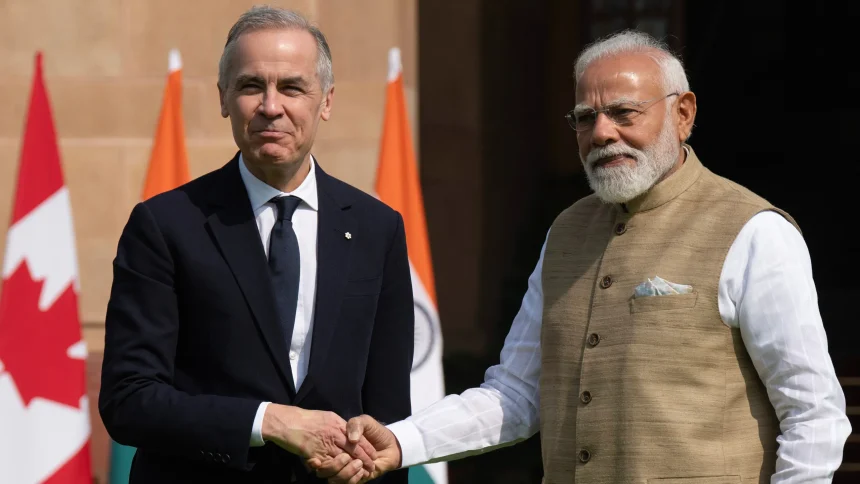
India and Canada have taken a decisive step toward repairing and deepening bilateral relations after years of diplomatic tension, signing a landmark long-term nuclear energy agreement that places uranium supply at the centre of a broader reset in ties. The deal, concluded during Canadian Prime Minister Mark Carney’s state visit to New Delhi, goes beyond energy cooperation to signal a renewed political and economic partnership after a prolonged period of mistrust and strained engagement.
A landmark moment in strained relations
The headline outcome of the meetings between Carney and Indian Prime Minister Narendra Modi was the announcement of a multi-billion-dollar long-term uranium supply agreement intended to support India’s expanding civil nuclear power programme. Though publicly quoted numbers vary, the pact is widely reported as being worth roughly C$2.6 billion (about $1.9–2.6 billion) — a substantial commitment by Canada to be a reliable nuclear fuel partner for India.
The deal marks a strategic pivot: after years of heightened diplomatic tensions that saw a breakdown of relations stemming from a dispute in 2023 over the killing of a Sikh activist in Canada and mutual expulsions of diplomats, both countries have agreed to bury the animosity and pursue cooperation on shared economic and security interests.
Filling India’s energy needs — and Canada’s export agenda
For India, the uranium agreement comes as the world’s most populous nation seeks to diversify and secure its energy mix. Civil nuclear power is a key plank of New Delhi’s strategy to expand low-carbon electricity production as it works to meet rising demand, reduce reliance on fossil fuels and meet climate commitments. Under the long-term supply pact, Canadian uranium — sourced through major producers such as Cameco Corp. — will be used in Indian reactors, including pressurised heavy-water units and future advanced designs.
While domestic nuclear power capacity remains a fraction of India’s overall electricity generation, the government has ambitious plans to scale up significantly in coming decades, including deploying small modular reactors and advanced nuclear technologies in collaboration with friendly partners.
For Canada, a leading uranium producer, the deal secures a high-value long-term export market and strengthens Ottawa’s broader economic strategy of diversifying trade partnerships beyond its traditional reliance on the United States. Carney’s push to expand Canadian trade in the Indo-Pacific — including future talks with Australia and Japan — underscores a geopolitical dimension to Canada’s renewed engagement with India.
Beyond uranium: a wider economic partnership
The uranium supply agreement is part of a broader package of cooperation across critical minerals, renewable energy, advanced technologies, and cultural and educational exchanges. Both leaders also agreed to recommit to negotiations on a Comprehensive Economic Partnership Agreement (CEPA), targeting the conclusion of a free trade pact by the end of 2026. The aim, according to official statements, is to grow bilateral trade from around $9 billion in recent years to approximately $50 billion by 2030 — a dramatic expansion of economic engagement.
Officials on both sides hailed the discussions as a reset marked by “new energy, mutual trust and positivity,” reflecting a deliberate effort to move past prior disputes and build enduring cooperation in areas of shared strategic interest.
Historical context: setbacks and resurgence
The relationship between India and Canada has seen significant ups and downs over the decades. Cooperation on nuclear and energy issues stretches back to the 1950s and 1960s — including Canada’s supply of research and reactor technology — but was disrupted after India’s first nuclear weapons test in 1974, leading Canada to suspend nuclear assistance under non-proliferation norms.
More recently, fiscal and diplomatic tensions peaked in 2023 following allegations by Canada regarding India’s involvement in the killing of a Canadian Sikh separatist on Canadian soil — a claim New Delhi vehemently denied. The episode resulted in diplomatic expulsions, travel advisories and suspended consular services, stalling bilateral engagement on economic and security fronts.
Carney’s visit and the nuclear deal suggest both capitals now see greater value in cooperation, prioritizing economic and strategic collaboration over lingering political disputes. The deal also reflects India’s globally outward-looking energy and industrial strategy and Canada’s desire to assert influence in fast-growing markets.
Strategic implications: energy, security and geopolitics
Beyond economic value, the nuclear energy agreement carries strategic overtones in a global context where energy security and clean power transitions are high priorities. India’s nuclear expansion is seen as part of a balanced energy strategy — complementing solar, wind and hydroelectric capacity — while Canada positions itself as a key partner supplying critical materials and technology.
The reset in relations could have further implications for defence cooperation, regional security dialogues and coordination on multilateral issues. Both New Delhi and Ottawa have underscored their interest in stable global energy markets, counterterrorism cooperation, and alignment on standards for trade governance.
Domestic pressures and diplomatic challenges
While leaders have emphasized forward-looking cooperation, the reset is not without critics. In Canada, questions remain about how Ottawa balances economic outreach with concerns over foreign interference and national security — a tension highlighted by ongoing domestic debate over the 2023 dispute. Observers warn that public sentiment in Canada could complicate political support for deepening ties if unresolved security matters resurface.
In India, expanding nuclear and clean energy capacity also brings regulatory, financial and environmental scrutiny. Deployment of new reactor technologies and long-term uranium imports will require robust safety frameworks, oversight and coordination with international civil nuclear norms.
A reset with global resonance
India and Canada’s landmark nuclear energy deal is more than an energy contract: it is a diplomatic signal that two large, diverse democracies can bridge a period of estrangement and pursue shared economic and strategic goals. As both nations work toward the CEPA and expanded collaboration across critical sectors, their renewed partnership may become a model of pragmatic diplomacy in an era defined by shifting trade patterns, geopolitical realignments and energy transitions.