






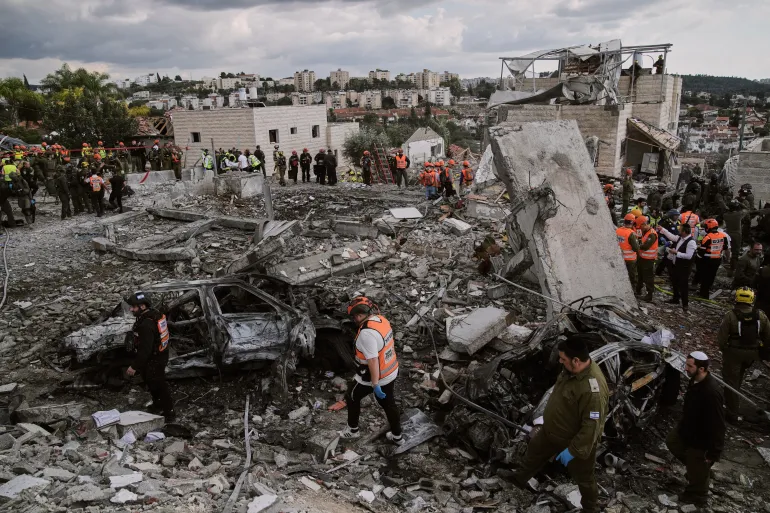
In a dramatic and far-reaching escalation of Middle Eastern conflict, the Islamic Republic of Iran has launched a sweeping campaign of retaliatory strikes across the region following coordinated military attacks by the United States and Israel on Iranian territory and leadership sites. Tehran’s response — involving missiles and drones directed at U.S. and allied military installations, as well as major urban and economic hubs in Gulf states — has thrust the wider region into profound uncertainty, with civilian casualties, infrastructure damage and diplomatic alarm mounting as the situation unfolds.
The reciprocal violence represents one of the most expansive cross-border military confrontations the Middle East has seen in decades, drawing in multiple states and raising the spectre of a wider war with global ramifications.
Origins of the Retaliatory Offensive
The latest chapter in the crisis began when the United States and Israel launched unprecedented airstrikes on targets inside Iran, including areas in and around the capital Tehran, in what Washington described as pre-emptive actions to degrade Tehran’s strategic capabilities. Reports indicate that the strikes resulted in heavy casualties and widespread damage within Iran, prompting a ferocious vowed response from Iranian leadership.
In the wake of those attacks, Iran’s Islamic Revolutionary Guard Corps (IRGC) issued statements declaring that all U.S. and Israeli assets and interests across the Middle East were “legitimate targets”, and on 28 February 2026 launched a barrage of missile and drone strikes aimed at key military and civilian sites across several countries.
Targets Across the Gulf and Beyond
Iran’s retaliatory strikes spanned a wide geographic area and diverse types of targets.
U.S. Military Installations
Tehran’s forces fired missiles and drones at multiple bases hosting U.S. forces. These included facilities in:
- Qatar, notably the Al Udeid Air Base, a key U.S. air operations hub;
- The United Arab Emirates — particularly the Al Dhafra Air Base near Abu Dhabi;
- Kuwait and Bahrain, where sites associated with the U.S. Fifth Fleet were struck or intercepted;
- Other allied positions across the Gulf region.
Iran’s strategy was openly framed as retaliation for the U.S.–Israeli assaults, with Tehran’s military leadership asserting that its actions would continue until “the enemy is decisively defeated.”
Gulf Cities and Civilian Infrastructure
In addition to military targets, Iranian missiles and unmanned systems impacted major urban and economic hubs:
- Dubai and Abu Dhabi (UAE) experienced debris and fires caused by intercepted projectiles, inflicting injuries and damaging portions of commercial centres and airports.
- Kuwait and Qatar reported shrapnel damage and disruptions to airport operations, with some key flight routes suspended.
- Bahrain saw explosive debris strike near the naval base and residential zones.
These attacks marked a significant escalation — civilian infrastructure, trade corridors and international aviation hubs were directly affected as well as U.S. military positions.
Human Toll and Civilian Disruption
The wave of strikes — both Iranian retaliation and the preceding U.S.–Israeli offensive — has inflicted significant human and economic costs:
- Iran’s own casualty figures from the initial strikes were reported to include over 200 deaths and hundreds of injuries across most of its provinces, according to health authorities.
- In the UAE, multiple foreign workers and civilians were killed or injured by debris and impacts from intercepted missiles and drones.
- Airports in major Gulf cities including Dubai International Airport were temporarily closed as a safety measure, displacing thousands of travellers and disrupting global air traffic.
The broader civilian impact — including fear across cities unaccustomed to aerial bombardment and economic losses from disrupted trade and transport — underscores the conflict’s reach beyond purely military objectives.
Regional and Global Diplomatic Fallout
The strikes have elicited intense diplomatic reactions:
- Gulf states such as the UAE condemned the attacks as violations of sovereignty and called on Tehran to de-escalate, even as they balance complex relationships with both Washington and Tehran.
- Arab governments have voiced alarm at Iran’s actions, warning that continued hostilities could destabilise the broader region.
- International organisations and foreign capitals have urged restraint and a return to diplomacy to forestall further escalation.
Analysts warn that miscalculations or additional cycles of retaliation could draw in other regional actors or shift the locus of conflict into a broader war involving multiple fronts and alliances.
Strategic Implications and Risks Ahead
Iran’s strategy of “internationalising” the battlefield — by striking U.S. assets in multiple countries and affecting civilian infrastructure — may be aimed at increasing the diplomatic and economic costs for Washington and its partners. Yet it also risks hardening support among Gulf states for their alliances with Western powers, even as those states seek to maintain stability and protect their populations.
The conflict’s impact on global energy markets is profound as well: disruptions along key maritime routes such as the Strait of Hormuz, through which a significant portion of the world’s oil supply transits, could push prices higher and reverberate through global systems already strained by geopolitical volatility.
Prospects for De-Escalation
Efforts at de-escalation face formidable obstacles, with national pride, strategic imperatives and domestic political pressures influencing decision-making on all sides. Diplomatic back channels, calls for ceasefires and third-party mediation efforts may yet emerge, but their success hinges on mutual willingness to halt military operations and negotiate terms acceptable to conflicting parties.
For now, the Middle East stands at a critical inflection point, and how Tehran’s broad retaliation shapes both regional alliances and global responses will define the trajectory of this conflict for months to come.