



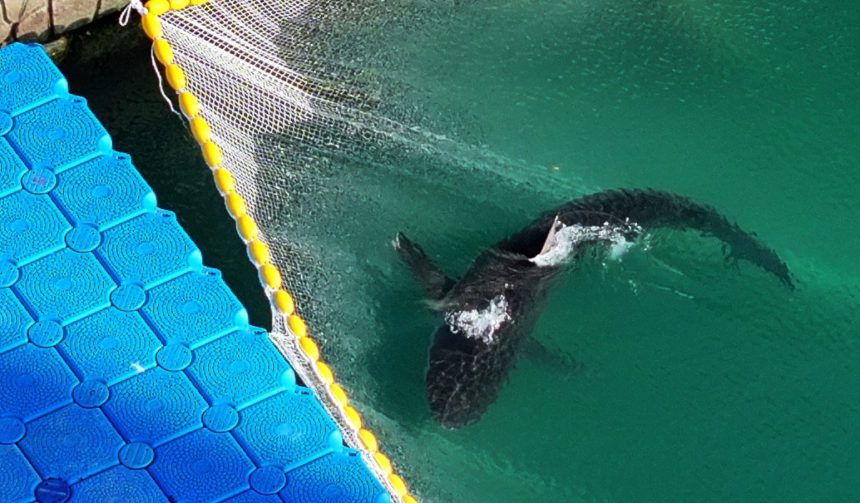
A dusky shark that spent a month turning a Busan canal into one of South Korea’s most-visited attractions has declined to take the exit her rescuers spent eight hours preparing for her. Bukangi, as the roughly three-metre female has been nicknamed, was coaxed into open harbour water on Wednesday, broke back through a barrier by Thursday morning, and has since been circling the mouth of the waterway without heading for the sea.
Eight hours, and then a U-turn
Wednesday’s operation was livestreamed by the city and watched by hundreds of people crowded into the park above the canal, who cheered and waved the shark off. Workers fixed nets to floating pontoons and edged them forward through the day, gradually narrowing her options until she passed into the harbour. A net barrier was then installed at the southern entrance of North Port Waterfront Park to stop her coming back.
It did not hold. By Thursday morning Bukangi had pushed through and re-entered the canal, where she became wedged in the gap between two layers of netting. Rescuers removed the outer layer to release her and reinforced what remained. She has since been venturing further out, then turning around again. A government official said on Thursday afternoon that the operation to free her had been wound up.
Why she stayed
The canal is about three metres deep — barely more than the shark’s own length — and offered what appears to have been an unusually comfortable set of conditions: warmer than normal water and an easy supply of fish. Marine specialists expect this to become less of an anomaly, warning that steadily rising sea temperatures make future shark visits to Busan more likely rather than less.
The same warmth that drew her in became the argument for getting her out. As autumn temperatures fell, officials grew concerned that she would be weakened by the cooling water, and there were signs she was already in trouble. She did not appear to be feeding, and videos circulating on social media showed her swimming with what looked like a bloodied snout.
A city that did not want to say goodbye
Bukangi was first spotted on 18 September, and the month that followed was an unexpected windfall for Busan. More than 1.6 million people came to look at her, and the city adopted her as an unofficial mascot. Two earlier attempts to net her out of the canal had already failed before this week’s effort.
That popularity cut against the rescue. Opinion in the city split sharply, and some residents turned up to the operation holding handwritten cardboard signs protesting her eviction. One, who had travelled two hours from North Gyeongsang province to see her, described the shark as “a rare gift” to Busan and argued that the canal had become her home — adding that she feared the animal was more likely to die tangled in netting or out at sea than left where she was.
Others took the opposite view, and the shark’s visible decline was central to it. One regular visitor said she had looked considerably bigger when he first saw her in mid-September and now appeared gaunt, leaving him worried about what another stretch in the canal would do to her. Another said the repeated returns were hard to watch and that the best outcome would be for her to leave, stay away and feed freely in open water — while acknowledging how much joy her month-long residency had brought to the city.
What happens now
With the formal operation closed, the position is unresolved: Bukangi is out of the canal but not out to sea, patrolling the boundary between the two. The reinforced netting is meant to keep her from going back in, leaving the final decision, in effect, to the shark.
Sources