



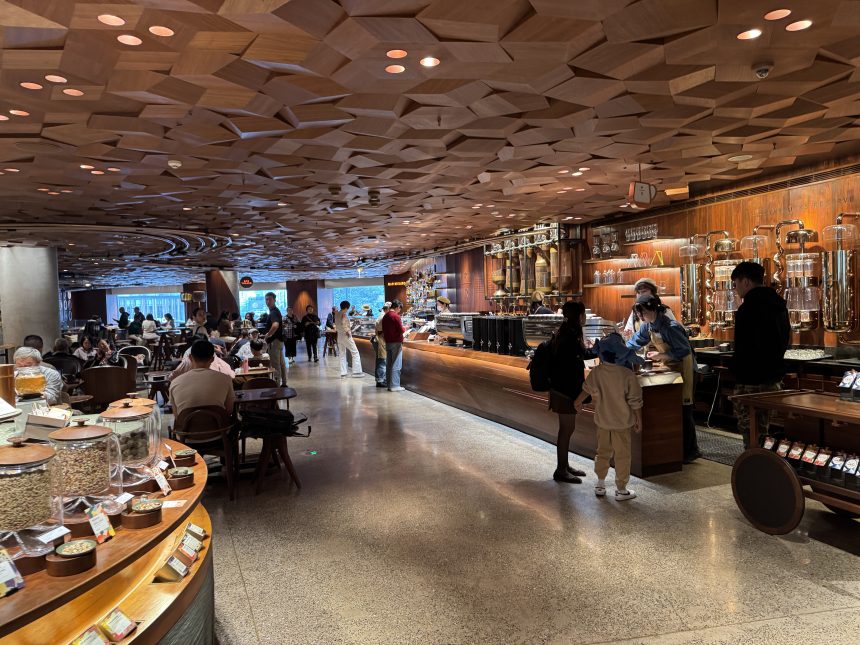
Starbucks has begun requiring customers in China to buy something before they can use the seating in its cafés, a nationwide rule that took effect on Thursday across roughly 8,000 outlets. Stores are displaying notices telling visitors that tables and chairs are reserved for paying customers — a quiet but symbolically loaded change for a chain that spent a quarter of a century selling the idea of the café as a place to linger.
What the rule actually says
The policy is simple in form: order first, then sit. It is not absolute, however. Pregnant customers and people with disabilities are exempted, and the company has framed enforcement as a matter of staff guiding visitors rather than turning them away at the door.
The seating change arrived alongside a spending commitment. Starbucks China said it will put more than 300 million yuan (about US$45 million) into its stores in the 2027 fiscal year, adding staff during peak hours, upgrading digital systems and core equipment, and refurbishing around 1,000 mainland locations. “We will continue investing resources to improve the in-store experience,” the company said in a statement, pledging to work with customers to maintain a welcoming third-place environment.
Why now
The trigger is crowding. Starbucks concluded that paying customers were being squeezed out during busy periods by visitors who ordered nothing at all, or who carried in cheaper coffee bought elsewhere and then occupied a table for hours. Store operations were strained in the process.
Tension over this has been building for a while. A seat-occupancy row flared across the Chinese market back in May 2024, at which point Starbucks China insisted publicly that it had never imposed a mandatory purchase-to-sit rule. In September 2025, a branch in Nanchong, Sichuan province, drew heavy criticism after chaining up its outdoor chairs and posting signs declaring them customers-only; the seating was unchained once the episode spread online.
Mixed signals from Chinese consumers
Videos of the new “purchase to sit” signage circulated widely on Chinese social platforms this week, and the reaction has been more sympathetic than the company might have feared. A number of users said they had struggled to find a seat precisely because of non-paying occupants, and welcomed the clarity.
That reception matters, because the rule cuts against the brand’s own marketing. Starbucks built its Chinese business on the “third place” concept — a space between home and office where customers were implicitly invited to stay. Putting a price on the chair redefines that promise even as the company insists it is protecting it.
A policy imported from North America
The move mirrors what Starbucks did in its home market. In January 2025 the company scrapped a nearly seven-year-old open-door policy that had allowed anyone to use its cafés, patios and restrooms without buying anything. That reversal came with a new code of conduct banning harassment, outside alcohol, smoking, vaping, drug use and panhandling, and was presented as a way to prioritise paying customers under chief executive Brian Niccol.
The original open-door rule had been introduced in 2018 after two Black men were arrested at a Philadelphia store where they had been waiting without ordering. Its removal in North America was followed by three quarters of rising comparable-store sales in fiscal 2026 — a track record that makes the Chinese version easier to justify internally.
Competitive pressure in the second-largest market
China is where Starbucks most needs the lift. The chain opened its first store in Beijing in 1999 and dominated the premium segment for years, but Luckin Coffee overtook it as the country’s largest coffee chain three years ago on the strength of drinks priced at a fraction of Starbucks levels. Consumers, meanwhile, have grown more cautious about discretionary spending and less willing to pay a premium for a foreign label.
The numbers reflect that squeeze. Same-store sales growth in China slowed to 0.5% in the first quarter of fiscal 2026, down from 7% the quarter before. Starbucks has since stopped breaking out Chinese performance separately, from the third quarter ended in June.
New ownership, new playbook
The business is also under new management. Starbucks announced in November 2025 that Chinese alternative-asset manager Boyu Capital would take operating control of its China arm through a joint venture, and the deal closed in April 2026 with Boyu holding 60% and Starbucks retaining 40%, along with ownership of the brand and intellectual property.
Under chief executive Molly Liu, the seating rule sits inside a wider “Third Place Initiative,” paired with a “Thousand Stores, Thousand Looks” strategy that diversifies store formats — from roughly 10-square-metre kiosks and coffee carts to outlets in office towers, hospitals, schools and themed locations — while shifting resources toward frontline operations. As small and grab-and-go formats multiply, the question of which stores still need to function as a lounge becomes a live one, and this week’s policy is the first clear answer.