





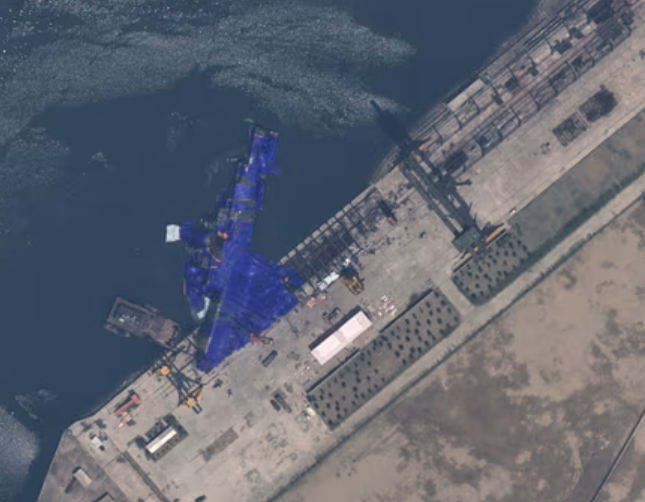
North Korea has successfully refloated a 5,000-ton Choe Hyon-class destroyer that capsized during a failed launch in May, marking a significant step in its naval modernization efforts.
Launch Mishap and Immediate Aftermath
On May 21, 2025, during a launch ceremony at the Chongjin Shipyard attended by leader Kim Jong Un, the destroyer capsized due to a malfunction in the sideways launch method. The stern entered the water while the bow remained on land, causing the vessel to tip onto its side . Kim condemned the incident as a “criminal act” resulting from “absolute carelessness” and ordered swift corrective measures.
Salvage Operations and Use of Balloons
In an unconventional salvage effort, North Korean workers utilized large white balloons and manual tethers to stabilize and right the vessel. Satellite imagery revealed approximately 40 such balloons near the capsized warship, leading experts to speculate on their role in providing buoyancy or obscuring aerial views . By early June, the ship was upright and moored at the pier, with plans to move it to a dry dock in Rajin for further repairs.
Detention of Officials and Political Implications
In response to the mishap, North Korean authorities detained at least four officials, including Ri Hyong-son, deputy director of the ruling Workers’ Party’s Munitions Industry Department. The detentions underscore the regime’s emphasis on accountability and the political sensitivity surrounding its military advancements.
Strategic Significance of the Choe Hyon-Class Destroyer
The Choe Hyon-class destroyer represents a significant leap in North Korea’s naval capabilities. Equipped with advanced missile systems and phased array radars, the vessel is designed to enhance the country’s maritime defense and offensive operations . Analysts believe that the destroyer could be capable of carrying nuclear-capable missiles, aligning with Kim Jong Un’s vision of a modernized, blue-water navy.
Future Outlook
Despite the initial setback, North Korea remains committed to its naval modernization program. The successful refloating of the destroyer and the ongoing repair efforts demonstrate the regime’s determination to project military strength and advance its strategic objectives . The incident also highlights the challenges North Korea faces in developing and deploying advanced military technology amidst international sanctions and limited resources.
As the repairs continue, the international community will closely monitor North Korea’s naval developments and their implications for regional security dynamics.