





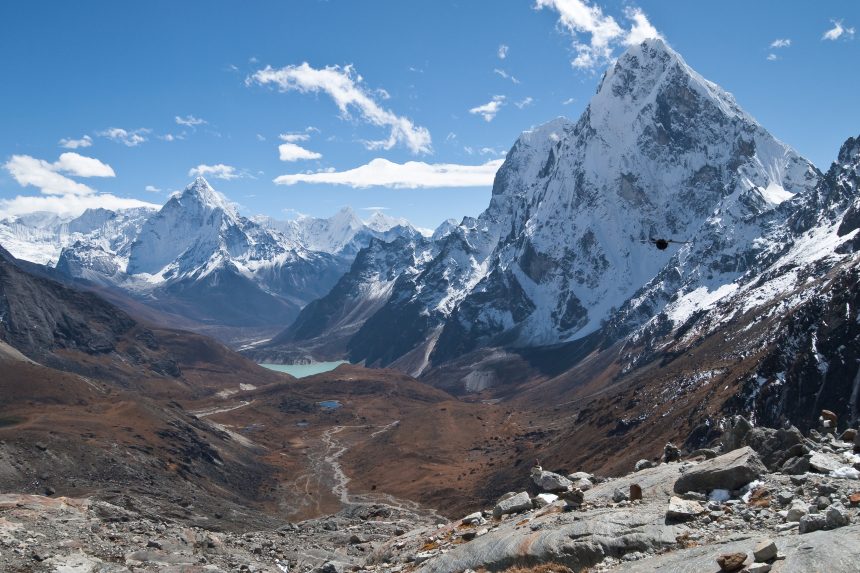
The Himalayas are losing ice at an accelerating rate, raising serious concerns over water supplies, agriculture, energy and economic stability across South Asia.
A new report warns that glaciers in the Hindu Kush Himalaya region are losing mass 65% faster than they were a decade ago, while researchers say the mountain system could be approaching a critical tipping point. The consequences could extend far beyond the mountains themselves, with India’s economy particularly exposed.
Glacier loss is accelerating
The Hindu Kush Himalaya region contains an estimated 40,000 glaciers, stretching across some of Asia’s most important river basins. Yet only a tiny fraction are monitored in detail, leaving major gaps in scientists’ understanding of how quickly the region is changing.
The International Centre for Integrated Mountain Development (ICIMOD) reported earlier this year that glacier wastage in the region has doubled since 2000. Its 2026 outlook warned that parts of the Himalayan cryosphere could be approaching critical tipping points, potentially leading to increasingly irreversible retreat.
The immediate effect of accelerating melt can be counterintuitive. More melting can temporarily increase river flows, but as glaciers shrink, that additional supply eventually disappears. Scientists warn that the region is approaching “peak water”, after which meltwater contributions to rivers are expected to decline.
India’s rivers depend on the Himalayas
The implications for India are enormous because Himalayan glaciers feed major river systems, including the Ganges, Yamuna and Brahmaputra.
Millions of people depend on these rivers for drinking water and agriculture. The rivers also support industrial activity and hydropower generation.
A changing supply of meltwater could therefore create a difficult combination: greater flooding and water availability in some periods, followed by increasing shortages as glaciers continue to retreat.
The threat is particularly serious because the Himalayas provide economic and environmental services far beyond the mountain states themselves.
Up to 20% of India’s GDP could be exposed
A recent report has estimated that the Himalayas underpin more than 20% of India’s GDP, making the health of the mountain ecosystem a national economic issue rather than simply an environmental concern.
Another report put the contribution at about 21.5% of India’s GDP, highlighting the huge economic value generated by water, agriculture, energy, tourism and other services connected to the Himalayan region.
That means disruptions to Himalayan water systems could ripple through the wider economy.
Agricultural production could be affected by unreliable water supplies. Hydropower projects could face changing river flows, while damage from floods, landslides and other disasters could require enormous spending on reconstruction.
Glacial lakes are becoming a growing danger
Rapid glacier retreat is also creating another hazard: expanding glacial lakes.
As glaciers shrink, meltwater can accumulate behind unstable walls of ice, rock and debris. If those barriers fail, enormous volumes of water can rush downstream in what is known as a glacial lake outburst flood.
Researchers have identified almost 200 high-risk glacial lakes in India, including 56 considered to be at very high risk. Several are connected to major river systems such as the Ganges and Yamuna.
The danger is not theoretical. Recent deadly flooding in the Himalayan region has demonstrated how quickly glacier-related disasters can destroy communities and infrastructure.
Mountain slopes are becoming less stable
The risks extend beyond water.
Warming temperatures are contributing to the thawing of permafrost and destabilising mountain slopes. Combined with shrinking glaciers, this can increase the likelihood of landslides, avalanches and massive debris flows.
A recent catastrophe in Nepal, where a glacier-related collapse contributed to devastating flooding, has provided a stark example of the destructive potential of these changes. Scientists say similar events could become more frequent as the Himalayan environment warms.
For India, the consequences could include damage to roads, bridges, villages, hydropower facilities and other critical infrastructure in mountain regions.
A monitoring problem makes the crisis harder
One of the biggest challenges is that scientists do not have enough information about many Himalayan glaciers.
Of the estimated 40,000 glaciers across the Hindu Kush Himalaya, only about 21 are being monitored in detail on a sustained basis, according to the latest regional assessment.
This lack of monitoring makes it harder to predict which glaciers and lakes pose the greatest risks and to establish effective early-warning systems.
Researchers are calling for better satellite monitoring, more ground-based observations and stronger cooperation between the countries that share the Himalayan river systems.
India faces a race against time
For India, the melting Himalayas represent a long-term economic challenge that cannot be separated from climate policy.
The country must prepare for two very different phases: increased water and flood risks as glaciers retreat rapidly, followed by the possibility of reduced dry-season water availability as the ice reserves diminish.
That could place pressure on food production, electricity generation and water supplies at the same time.
The Himalayas have long been regarded as a natural water tower for Asia. But scientists increasingly warn that this water tower is changing rapidly — and that the economic consequences could reach far beyond the mountains.
The central challenge for India is now not simply to slow the melting, but to prepare for a future in which the Himalayas can no longer be relied upon to provide water in the same way they have for generations.
Sources
- Reuters — Himalayas approaching tipping point, millions of livelihoods at stake
- ICIMOD — Hindu Kush Himalaya glaciers losing ice at double the rate since 2000
- The Economic Times — Himalayas running out of water, 20% of India’s GDP at risk
- Times of India — Himalayas nearing tipping point: Glacier loss puts India at risk
- Associated Press — Nepal floods highlight growing glacier risks in warming Himalayas